
Reflections on Wyoming’s New Mandate and the Future of Catch & Release
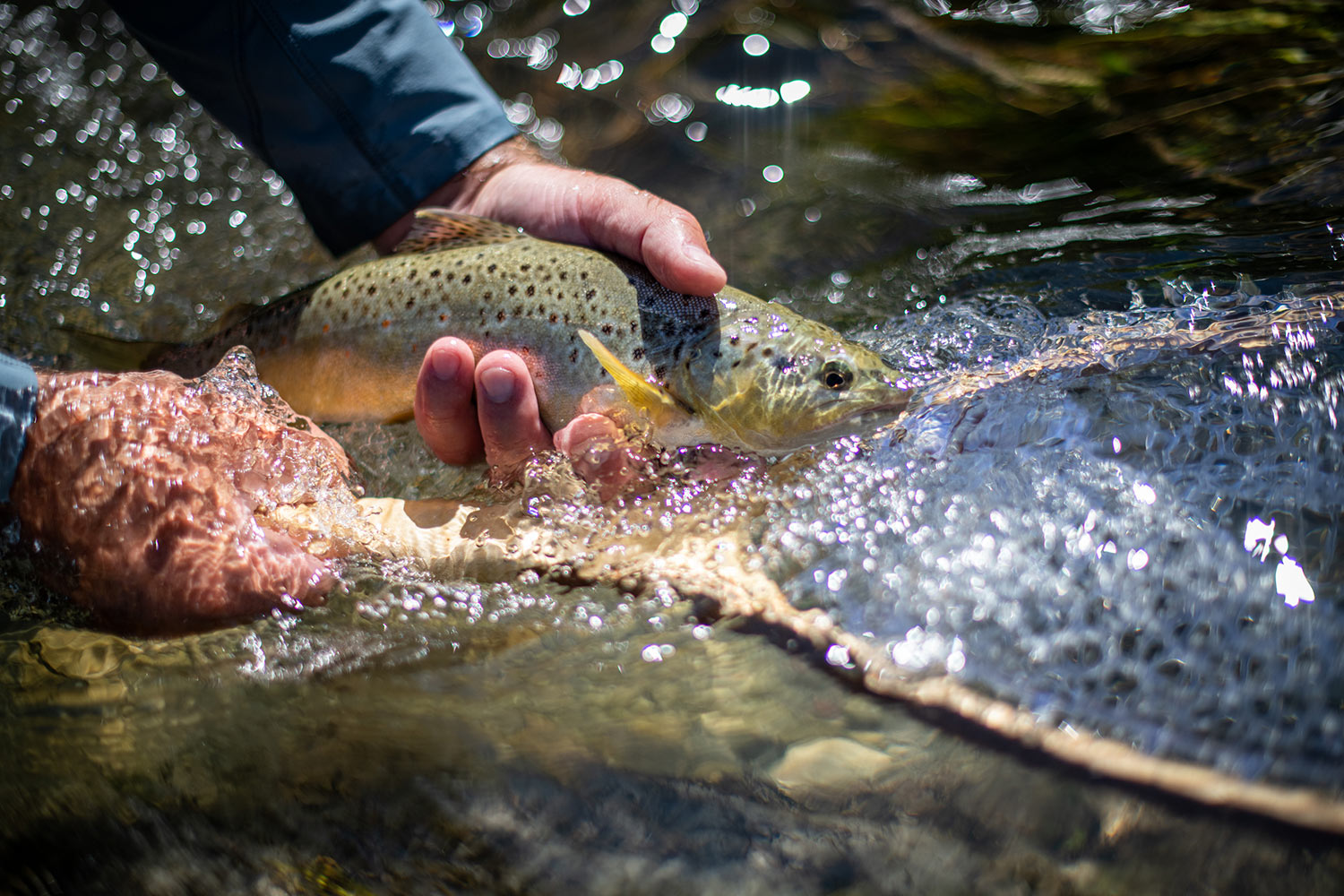
What responsibility do we carry when we release a fish?
It’s a question that tends to show up in quiet moments - watching a trout slip back into the current…
or easing a hook free from a fish that fought a little harder than expected.
This winter, that question took on new weight.
As of January 2026, anglers fishing sections of Wyoming’s North Platte River are required to use barbless hooks.
For some, it feels like a big shift, for others, it feels overdue. For us, it feels like a reminder.
Loved to Death
The North Platte is one of those rare rivers that lives up to its reputation.
Wide water. Big skies. Trout that feel almost too good to be true.
But rivers like that come with a cost.
Biologists studying fish in the Miracle Mile found that more than 70% of trout showed evidence of prior hookings. Scar tissue. Worn jaws. Fish that had clearly been caught - and released - again and again.
That’s the reality of pressure.
Not from bad intent.
But from success.
When thousands of anglers are doing the right thing - catching and releasing fish - the cumulative impact still adds up.
Wyoming’s response was simple:
If fish are going to be caught repeatedly, every release should be as clean as possible.
What Actually Changes
There’s a perception that barbless hooks are a compromise - that you’ll lose more fish, that they’re only for purists, etc.
But most anglers who make the switch notice something different.
The fight doesn’t really change, just the ending.
Hooks come out faster. Fish spend less time in your hands. There’s less fumbling, less stress - for both the fish and the angler.
And after a while, it starts to feel… right. Less like a rule, more like a refinement.
Beyond Regulation
Rules like this matter. They protect heavily pressured fisheries and create a baseline for responsible angling.
But the future of our rivers won’t be shaped by regulation alone.
It will be shaped by individual decisions - made one fish at a time.
Long before barbless hooks were required, many anglers chose them anyway.
Not because they had to.
Because it aligned with how they wanted to fish.
A Quiet Standard
That idea has always been at the core of what we believe: If you’re going to release a fish, you should give it the best possible chance to swim away clean.
Closing
Maybe barbless becomes the standard everywhere.
Maybe it doesn’t.
But the real shift isn’t in the regulation.
It’s in the awareness.
Because once you’ve seen the difference - it’s hard to unsee it.
For a deeper dive into the science and regulations behind barbless fishing, visit our Why Barbless?
For the tyer’s side of barbless, how the point sets, holds, and ties, see Are Barbless Hooks Better? on the Bench.



1 comment
Darryl Hussey
Thank you for this! Here in British Columbia our Provincial Recreational Fisheries managers have taken the unprecedented step to be regressive and “de-regulate” the vast majority of our quality, high incident – C&R fisheries to barbs and bait. After just a few months in year one (last season) the facial injuries, missing maxilla’s, blind eyes, etc – the unnecessary cumulative injuries, were already evident in many popular fisheries. Glad to,tie with Firehole -,100% barbless. Thanks for what you do!
Leave a comment
All comments are moderated before being published.
This site is protected by hCaptcha and the hCaptcha Privacy Policy and Terms of Service apply.