
Guest post by Chris Higgins
Why do you fish? A frequently asked question. One I like answering. One that causes some self-reflection. One that brings back good memories of vibrant orange sunrises and the purplest of purple sunsets. Memories of running from storms and hiding from relentless winds. Memories of countless stories, endless lies and more sunburns than I care to share with doctors.
I fish because I want to be outside.
I fish because I need a break from technology.
I fish because I get to spend time with people I really like. (I don’t think I have ever purposely gone fishing with someone I don’t like. Why would I do that?)
I fish—and more importantly, I fly fish using as little technology as humanly possible—because I like problem-solving.
And I fish because, no matter how many times I fail, there is always hope and reward in the next cast.
The more I thought about those reasons, the more I realized they had less to do with fishing and more to do with how I live.
Balance
There are only a fortunate few who can buck social norms, go against the flow, and not care about earnings, career, what others think, or what we are supposed to want or have. I am not one of those fortunate few. I am as guilty as anyone of falling into the trap of overworking, if only to fill the needs of a competitive, consumer lifestyle—one in which I am constantly working “more,” constantly wanting “more,” often for more of whatever it is I don’t need.
While it is true that with age comes wisdom (at least for some), it is also equally true that old habits die hard. Even with age, I have not learned how to stop participating in the rat race of life.
What I have learned with age, however, is that being outside is good for the soul. It allows you to slow down, clear your mind, and focus on the present—the opposite of most of our daily routines. Add fly fishing and the rhythm of casting, and my best days become meditative, focusing on nothing more than the water in front of me and the cadence of the cast. Those days are glorious. But those moments don’t happen by accident, and they don’t happen if I let the modern world follow me to the water.
Presence
Those days are also not possible if I am constantly thinking about or being interrupted by the supercomputer in my pocket. I am not anti-technology; I am fully aware that my life would not be what it is without it. I do think we are reaching a stage where we are overdoing it and losing a healthy balance. So I actively search for places where technology does not work, nor does it need to. I find that simply taking a break for a few hours or days each month is enough to help me reset, remember where I fit as a relatively small part of the world, and find the balance that keeps me happy.
Part of finding that balance is refocusing on my relationships. Heading to a river or lake with no technology allows you to truly enjoy those around you—whether that’s family, friends, or anyone within the community you build along the way. A day of fishing almost always comes with stories of past trips, plans for future adventures, or, when needed, time to work through problems with people you trust.
I am also one of the fortunate few who has a spouse who shares my love for fishing and the water—someone who gets the same joy from hiking the banks of a river, a full-day float, or a sunny, hot perch on the bow of a flats skiff. A day on the water represents more than a day of fishing. For us, it replaces date night. It gives us reasons to take vacations, a reason for celebrations and it can all be done on whatever budget we have available at the time.
Hope
Take away the philosophical BS, and this is where fishing gets very real for me. Even when surrounded by friends and family, fishing comes with quiet. Better than any therapy, it allows you the time to work your shit out. I choose to fish with little to no technology. Why? I like to force myself to think about fishing. Let’s face it: it’s easy to bring the problems of day-to-day life with you. If you rely on technology to read the water and tell you where and when to fish, you can easily continue thinking about all the things you were trying to leave behind.
I like solving those problems for myself—overcoming technical casting challenges (timing and accuracy), achieving the perfect drag-free drift, selecting the right fly, managing tangles and knots, staying out of the trees, and, even more importantly, tackling mental challenges like impatience and focus. Then I think about the water itself, determining how to get the fly to the right spot or depth while cursing the wind and the obstacles I put in my own way. These puzzles are not only rewarding to solve (because solving them produces the tug), but they also allow you to forget your worries, even if only for a few hours.
Somewhere between solving those little problems and quieting my mind, I always arrive at the same place. I fish because there is always hope—and I always need more hope. Hope brings motivation: the idea that my reward is just around the bend. If not the next bend, then definitely the one after that. Hope is one of the most powerful feelings known to mankind. It creates a mindset that allows you to imagine a better future and gives you the freedom to believe you have the ability, skills, and plan to work toward that future, even amid uncertainty or adversity.
Grounded Optimism
So there you have it. I’ve just given you hundreds of words on why you should fish, based on why I fish. I fish for balance in my life. Presence of mind. Hope of a better outcome on the next cast. Nowhere in here did I tell you to fish in order to catch fish—that part is simply a bonus, and one I could easily spend another thousand words on. I also never talked about keeping a few fish, the joy of sharing a catch with friends and family, or the stories created while enjoying a well-prepared meal cooked over an open fire.
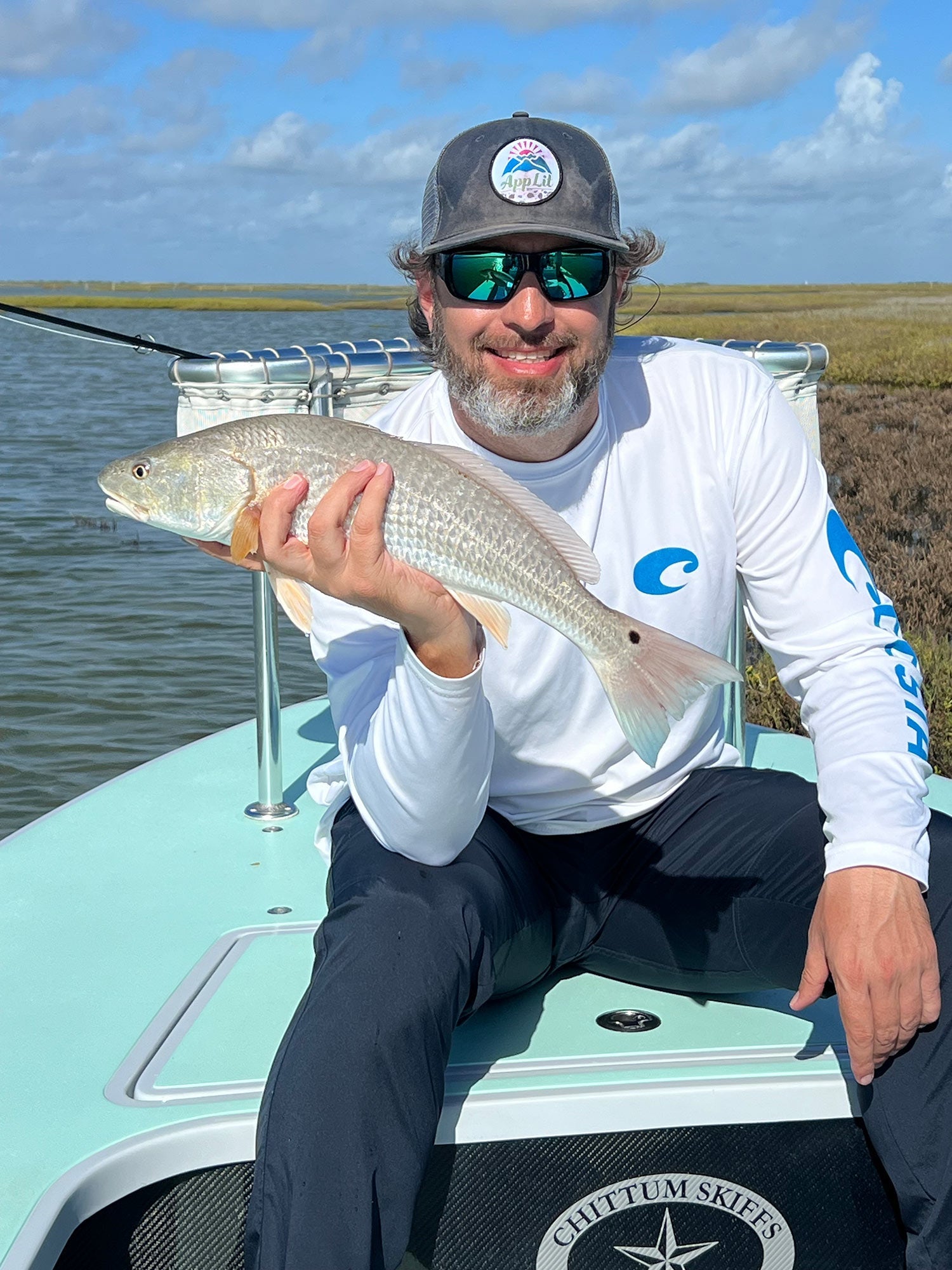
The reasons I fish are endless, and the reason I fish is seldom about the fish. That said, I will brag like hell if I ever catch a monster trout, bass, redfish, or permit.
Thoughts and opinions of just another average fly fisherman.
About The Author:
Chris Higgins is proud to be a consistently mediocre fly fisherman who spends his free time floating or wading whatever waters he can access. He often catches more observations than fish. Those moments on the water fuel his writing, which focuses on reflection, curiosity, and the life lessons found between casts.
Professionally, he owns and operates businesses in the commercial horticulture industry, working to build and strengthen communities through innovative farming and healthy food. Whether in a greenhouse or on a river, he believes paying attention matters more than perfection.

2 comments
Dan Kochanek
What app helps you learn the water and what bugs are hatching, because I’ve never heard of such a thing. Not that I would use it. I like to figure things on my own. But that App needs to go away.
Freddy
Hey Chris -
Great read and I can relate to many of things you shared! Appreciate you sharing this!
After a conversation with a fly angler friend of mine (quite accomplished at it too), I told him I really was not able to put in words why I fish while knowing in my heart of hearts, it wasn’t about the “fish” much at all. I absolutely love the gear, the drug of the tug, landing a fish ir two, but those are all simply “bonus” items. This sums it up for me – you should go find and read this if you or other readers have not: “Testament of a Fisherman” (by Robert Traver was his pen name—his real name was John Voelker) .
Enjoy!
All the best – Freddy
Leave a comment
All comments are moderated before being published.
This site is protected by hCaptcha and the hCaptcha Privacy Policy and Terms of Service apply.