
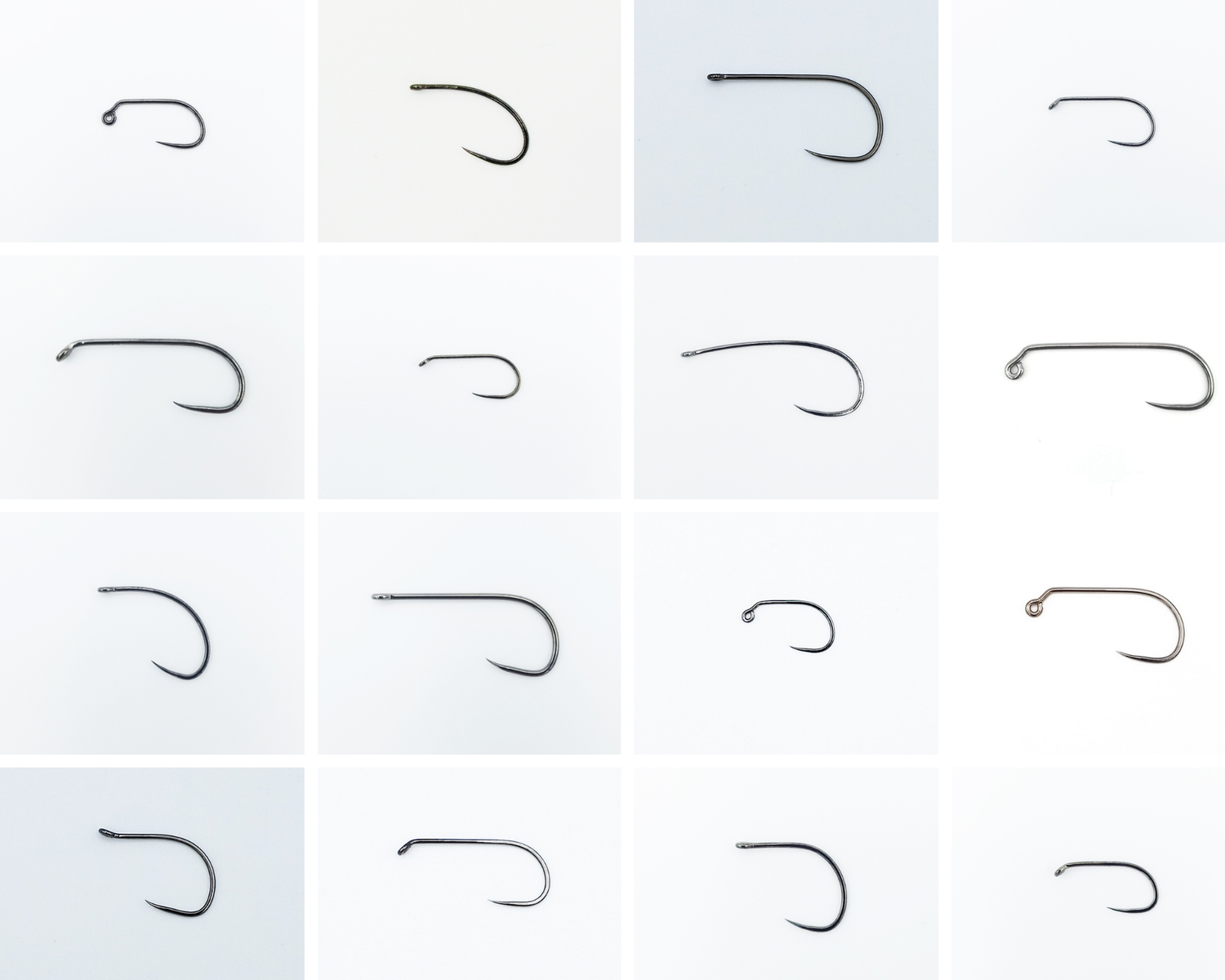
Firehole Sticks run 28 models, all barbless. That is deliberate. A tyer who fishes dries, nymphs, jigs, and streamers should not have to compromise on any of them. The number sounds like a lot until you sort it by what you actually tie, which is how this guide is built. Find your fly, then check the size range and wire weight.
For nymphs and wets
- 609 is the standard nymph hook. Start here for most bead-head and unweighted nymphs. #8 to #20.
- 633 is a longer, heavier nymph and wet hook with room for a bead, built for deep, fast water. #10 to #22.
- 637 is a strong short nymph that doubles for wets and egg patterns. #6 to #22.
- 612 is a straight-eye nymph, which lets you run a slightly larger bead and keeps the fly aligned. #10 to #18.
- 618 is a long-shank hook for big nymphs, foam, and hoppers. #4 to #16.
- 718 is the heavy-wire all-purpose hook: nymphs, wets, hoppers, small streamers. If you want one versatile hook, this is it. #4 to #24.
For scuds, czech nymphs, and emergers
These are all curved-shank hooks. The curve is the shape; scud, czech nymph, pupa, and emerger are the patterns you tie on it. A shorter curve suits scuds and pupa, a longer one suits czech nymphs, and a heavier one handles stoneflies. Pick by wire weight and length.
- 317 is a light-wire curve for emergers, nymphs, and Klinkhammers, with a broad size range. #10 to #24.
- 320 is a compact, medium-wire curve for scuds and pupa. #10 to #20.
- 321 is a pupa and scud hook with an offset point that can help hookups. #8 to #18.
- 315 is a heavy-wire curve for czech nymphs, stoneflies, caddis emergers, and small klinkhammers. #6 to #22.
- 316 is a medium-wire curve for nymphs and emergers, and it runs down to the tiny sizes. #6 to #26.
For dry flies
- 419 is a light-wire, high-floating dry fly hook, at its best on smaller patterns. #8 to #24.
- 413 is a shorter dry and all-purpose hook with a balanced wire weight. #8 to #24.
For euro and jig nymphs
- 516 is the everyday euro jig, and our best-selling bead pairing. #4 to #24.
- 520 shares the heaviest wire in the jig line and is built to carry a bigger bead. #4 to #20.
- 551 is a long, heavy jig for deep, fast water. #4 to #20.
- 535 is a 60-degree jig with the eye turned perpendicular to the shank, so a larger bead seats without risk of slipping off. #10 to #18.
- 523 is a stonefly and crawler jig with extra length and strength. #4 to #14.
New to euro? Our guide to pairing jig hooks with slotted beads covers the rest.
For streamers
- 839 is the universal long-shank streamer and woolly bugger hook. Start here. #2 to #18.
- 811 is a long-shank streamer and stinger hook. #1 to #10.
- 826 has a 26-degree up-bend for a jigging action, in single and articulated flies. #1/0 to #10.
- 860 is an extra-wide-gape streamer with room for bulky patterns. #1 to #8.
- 511 is a 90-degree jig streamer for point-up streamers on a bead. #2 to #8.
- 570 is a long-shank jig streamer for big profiles. #1 to #8.
- 714 is an intruder and trailer hook for articulated and swung flies. #1 to #8.
For predators and salt
- 801P is a heavy predator streamer hook with an extra-wide gape. #1 to #5/0.
- 802P is the longer version, built for the biggest flies. #1 to #5/0.
- 803P is a predator stinger for articulated and single-hook flies. #1/0 to #5/0.
Shanks
For articulated streamers, the shanks (AS1, AS2, and the straight SS) give you a bead-and-body platform ahead of a trailer hook. They are tying components, not hooks.
Reading the numbers
Once you know the system, the model number tells you what a hook is:
- 300 continuous curves (scuds, czech nymphs, pupa, emergers)
- 400 dry fly
- 500 jig
- 600 nymph and wet
- 700 all-purpose and specialty
- 800 streamer and predator
The whole line at a glance
Every model, with the hook itself. Tap a hook or a number to go to its page.
| Hook | Model | What it's for | Sizes |
|---|---|---|---|
 |
315 | Curved: czech nymph, stone, klink | #6 to #22 |
 |
316 | Curved: nymph, emerger | #6 to #26 |
 |
317 | Curved: emerger, nymph, klink | #10 to #24 |
 |
320 | Curved: scud, pupa (medium) | #10 to #20 |
 |
321 | Curved: pupa, scud, offset | #8 to #18 |
 |
413 | Dry, all-purpose (short) | #8 to #24 |
 |
419 | Dry (light wire) | #8 to #24 |
 |
511 | 90-degree jig streamer | #2 to #8 |
 |
516 | Jig (euro) | #4 to #24 |
 |
520 | Jig, heavy, big beads | #4 to #20 |
 |
523 | Stonefly jig | #4 to #14 |
 |
535 | Jig, larger bead | #10 to #18 |
 |
551 | Jig, long, deep | #4 to #20 |
 |
570 | Jig streamer, long | #1 to #8 |
 |
609 | Standard nymph, wet | #8 to #20 |
 |
612 | Nymph, straight eye | #10 to #18 |
 |
618 | Long nymph, foam, hopper | #4 to #16 |
 |
633 | Long nymph, wet (heavy) | #10 to #22 |
 |
637 | Nymph, wet, egg | #6 to #22 |
 |
714 | Intruder, trailer | #1 to #8 |
 |
718 | All-purpose, heavy wire | #4 to #24 |
 |
801P | Predator streamer | #1 to #5/0 |
 |
802P | Predator streamer, long | #1 to #5/0 |
 |
803P | Predator stinger, articulated | #1/0 to #5/0 |
 |
811 | Streamer, stinger | #1 to #10 |
 |
826 | 26-degree bend streamer | #1/0 to #10 |
 |
839 | Streamer, bugger | #2 to #18 |
 |
860 | Streamer, extra-wide gape | #1 to #8 |
Still deciding? Match the bead while you are at it with our tungsten bead size chart, or browse the full Firehole Sticks line.

4 comments
Mark Roberts
Great information. Very helpful when pairing sticks and stones. Good work
John Richard Harcourt
We are an independent outfitter for 30 years, Harcourt Fly Fishing 3G (3 generations) and use to have a pro form with your company until the previous owner discontinued the option. We have pro forms with Orvis, Far Bank (sage and Redington, Fishpond) Umpqua (Tiempco hooks), Temple Fork Outfitters, etc. Are you now offering a pro form? Best Wishes and Tight Lines
Jeff Waugh
You are doing a great job John!! All I use is Firehole from the very beginning. Keep up the great work, and I can’t wait to see if you bring out some specialty hooks in the future!
Jeff Welker
Helpful information – thank you. For me, it would have been more helpful if the “The whole line at a glance” chart (?) had included images of the hooks, or, if the images at the beginning of this article had included the model numbers. I would have helped me more quickly identify the model hooks I most want to acquire. Just my 2-cents. Thanks for your great products. I generally get all my fly tying supplies, including hooks, from Fly Fish Food in Orem, Utah – even though I live in Arizona.
Leave a comment
All comments are moderated before being published.
This site is protected by hCaptcha and the hCaptcha Privacy Policy and Terms of Service apply.