
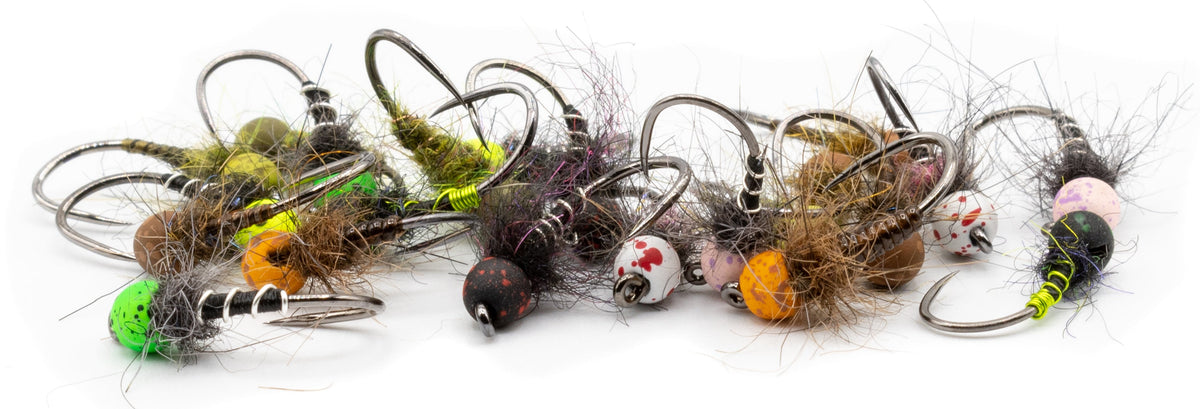
The wrong bead size is the most common reason a good pattern fishes badly. Too big and the fly looks clumsy and rides nose-down. Too small and it never gets to the fish. Here is the chart we use at the Firehole bench, plus the two rules that make it work.
Rule 1: Match the bead to the hook
Two shapes, two jobs.
Slotted beads seat on jig hooks, including jig streamers like the 511. The slot clears the bend of a jig hook so the bead can seat at the eye, and with the weight up front the fly tends to ride point-up. If you tie euro nymphs on a 516 or a 551, you want slotted.
Round beads go on standard nymph and wet hooks, and on the curved 300 series. Straight or slightly curved shank, round bore, clean fit.
Dry flies, foam hoppers, and articulated shanks are not bead hooks. Leave them bare.
Which Stone, then?
Tying on a jig hook? Slotted Tungsten Stones.
Nymph, wet, curved or all-purpose hook? Round Tungsten Stones.
Want weight and profile set separately? Stack a Stone with a Bug Band or Tear Drop. See the Stone Stack.
Every bead hook in the line now shows the right Stone for each hook size on its product page.
Rule 2: Size to the hook, and when in doubt, size down
Tungsten is dense, close to twice the weight of brass at the same diameter. That is why it sinks a fly so well, and it is also why an oversized bead looks bulky and throws off the profile.
When you are between two sizes, drop to the smaller one. Be clear about the trade. A bead's weight falls away fast as the diameter comes down, so the smaller Stone does sink slower than the larger one. Tungsten is what makes the trade worth taking: the smaller Stone still carries more metal than the brass bead most tyers would have reached for, and the fly keeps its profile.
The chart
Find your bead size, then read across to the hooks it fits. These are the ranges printed on our bead packaging.
| Bead (mm) | Nearest inch | Hook size |
|---|---|---|
| 1.5 mm* | ~1/16" | #22 – #24 |
| 2.0 mm | 5/64" | #18 – #22 |
| 2.5 mm | 3/32" | #14 – #18 |
| 3.0 mm | ~1/8" | #12 – #16 |
| 3.5 mm | 9/64" | #10 – #14 |
| 4.0 mm | 5/32" | #8 – #12 |
| 4.5 mm | ~3/16" | #4 – #8 |
*1.5 mm is slotted only. The fractions are the nearest common size, not exact, so order by the millimeter. Tungsten is about twice the density of brass, so when you are between sizes, size down. The 4.5 mm is our largest Stone and tops out at a #4 hook; on streamer hooks larger than #4 it will not fit the wire.

If you want the naturalistic look, every size from 2.0 mm up is also offered in a speckled finish. Same sizing, same fit. Browse the Round Tungsten Stones and pick the color later.
What each Stone weighs
The chart tells you what fits. Weight tells you how fast it gets down. These are raw tungsten, in grams. Paint and matte finishes add about a hundredth.
| Bead (mm) | Slotted | Round |
|---|---|---|
| 1.5 mm | 0.03 g | not made |
| 2.0 mm | 0.05 g | 0.05 g |
| 2.5 mm | 0.11 g | 0.10 g |
| 3.0 mm | 0.21 g | 0.18 g |
| 3.5 mm | 0.33 g | 0.30 g |
| 4.0 mm | 0.48 g | 0.44 g |
| 4.5 mm | 0.72 g | 0.69 g |
Slotted runs a few hundredths heavier than round from 2.5 mm up, because the smaller bore leaves more tungsten in the bead. The gap is small on purpose, so a pattern can move between a jig hook and a standard nymph hook without redoing the weight.
Look at how fast the numbers climb. Going from 3.0 to 3.5 mm adds 0.12 grams and a bigger head whether you wanted either or not. If you need more weight but like the head you have, add it behind the bead instead: a Tear Drop body adds 0.10 to 0.72 grams, and a Bug Band adds 0.02 to 0.14. The pieces add straight up, and the Stone Stack has every combination worked out.
Not sure which hook to start with? Our guide to choosing a fly tying hook sorts the whole line by what you tie.
Going heavier on purpose? The chart above keeps your fly balanced and natural. Euro nymphers sometimes want the opposite: the biggest bead a hook will take, to punch a fly to the bottom fast. A few jig hooks like the 535 are built for exactly that. We cover oversizing in its own guide: oversizing tungsten beads.
One more thing on weight
Because tungsten carries so much weight for its size, you can drop a size and still get down. On a size 14 nymph where a brass tyer reaches for 3.0 mm, a 2.5 mm tungsten Stone often sinks the same or faster with a slimmer profile. That is the whole point of tying with tungsten.
Match the shape, match the size, size down when you are unsure. Everything else is color.
Shop Round Tungsten Stones for standard nymphs, or Slotted Tungsten Stones for jig and euro patterns.

Leave a comment
All comments are moderated before being published.
This site is protected by hCaptcha and the hCaptcha Privacy Policy and Terms of Service apply.