
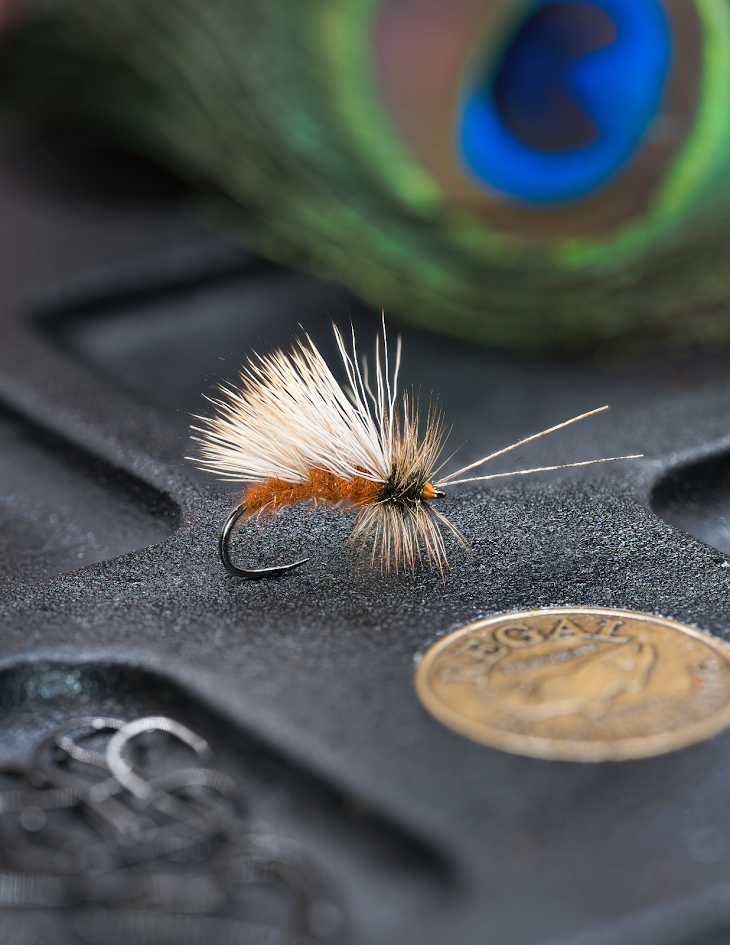
If you have the Autumn issue of Fly Tyer on the bench, our ad is the October Caddis on page 5. Freddy Block tied it and shot it, on a Firehole Sticks 718.
It is a good fly, and it is the fall's best excuse to fish a big dry. Here is what is worth knowing before you do.
One name, two groups of caddis
"October caddis" is an angler's name, not a taxonomic one, and it covers two different groups of insects. Each is a genus holding several species, which is part of why published advice on this hatch contradicts itself so often.
West: Dicosmoecus, commonly called the Giant Orange Sedge and found across much of the West, including Oregon, Washington, northern California, Idaho, Montana, and Colorado. These are genuinely large caddisflies, with adults approaching an inch or more in overall length. Most western patterns run #6 to #10. Start at #8.
East and Midwest: Pycnopsyche, the Great Autumn Brown Sedge, found primarily east of the Rockies. Anglers here have called it the October caddis for a long time and are not wrong to. Smaller, and patterns run #10 to #12 in New Jersey and Pennsylvania, with #10 to #14 reasonable across the wider region. Pumpkin orange to rusty brown, often with mottled or spotted brown wings. It can show as early as mid-August, often peaks around early October, and may persist into November on southern waters.
The practical difference is usually size. Western imitations generally run larger, but the insects in front of you and the proportions of the hook you are tying on should make the final call.
Much of the emergence happens along the margins
This is the most useful thing on this page.
Unlike many caddisflies that rise through open water and emerge in the surface film, October caddis pupae commonly swim or crawl toward shore. Many leave the water entirely, splitting their shucks on rocks, logs, and streamside structure.
Not every insect takes that route. Out West in particular, some emerge in the river. But the migration toward shore concentrates vulnerable pupae along the banks, and that is the fishing lesson: do not cast down the middle out of habit. Work the first few feet off the bank, the soft water beside boulders and logs, riffles tapering into tailouts, and the seams that connect fast water to the margins.
Low light is best, but do not write off the afternoon
Adults spend much of the day resting in streamside vegetation and become more active late in the day. Emergence and egg-laying build through the afternoon and are strongest near dusk, particularly out West. In the East, a good deal of the emergence happens after dark.
Heavy cloud, shade, and light rain stretch the surface window. The middle of a bright day is lower-percentage for the dry, though a big October caddis still works as a searching pattern along shaded banks and broken water.
Go early for a different reason. First light is when you find fresh shucks on the rocks, and shucks tell you exactly where last night's emergence happened. That is scouting, not a feeding window, and it is worth more than most people give it credit for.
The dry fly, and what the female may be doing
Egg-laying is another place the common name causes confusion, and it is worth being straight about what is known.
Eastern Pycnopsyche females have been documented landing on shoreline objects and crawling underwater to deposit their eggs. Western Dicosmoecus egg masses have been found at the bases of streamside sedges and reported on foliage overhanging the water, with surface oviposition described in the literature as anecdotal rather than established. Anglers in both the East and West do report females touching down and struggling on the surface.
For the angler, the conclusion is simpler than the entomology. Adults may be available on top, and egg-laying females and migrating pupae may also put fish on subsurface imitations near the margins. Carry both.
Start the dry with a dead drift. If that does not move a fish, add an occasional twitch, a hop, or a controlled skate. Egg-laying and struggling caddis are active insects, and movement can turn a look into a take. You can blind-cast a big one along a good bank without seeing a rise first.
Worth hearing from people who guide this in Maine: they will tell you fall dry fly fishing in New England is either everything or nothing. The fish are all over it, or they ignore it completely. That is their experience of it, and it matches what a lot of eastern anglers describe.
The soft hackle
An orange-bodied soft hackle is the natural companion to the dry. In the East, a Partridge and Orange or Tim Flagler's October caddis soft hackle, around #10 to #12, is a good place to start. For the larger western insect, go to a fuller orange and brown soft hackle or pupa in #6 to #10.
Cast down and across, swing it through the slow edges, and hang it at the end of the swing longer than feels right. Flagler walks the pattern through step by step in his Beginner's Masterclass column in Fly Tyer. He ties and fishes it on the waters of northwestern New Jersey and eastern Pennsylvania, the eastern October caddis fishery it was built around.
The other two stages
The adult gets the attention, but these insects spend most of their lives as cased larvae on the bottom. Before pupation, mature larvae commonly seal themselves into their cases and go dormant, sometimes for weeks or months, before pupating in late summer or early fall.
That gives you three distinct opportunities rather than one: the larva, the migrating or emerging pupa, and the adult.
Fish a pupa deep under an indicator, or swing it through a riffle on a tight line ahead of the emergence. For the larva, a weighted jig pattern tight-lined along the bottom is a standard approach, and it works well before anything is happening on top. Our 516 and 520 are the obvious homes for that pattern. Both are heavy-wire jig hooks: the 516 has a standard-length shank and 60-degree eye, while the 520 has a longer continuous bend and wider gap.
Why the 718 for the adult
An October caddis is a heavily dressed fly at either size. Deer or elk hair wing, palmered hackle, a dense collar. All of that crowds the hook, and on a standard-gap dry fly hook it crowds the one part that has to stay clear.
The Firehole Sticks 718 runs a 2XG+ gap, which leaves useful clearance beneath a heavily dressed body and wing. That is the argument, and it matters more on this fly than on almost anything else you tie.
Three things follow.
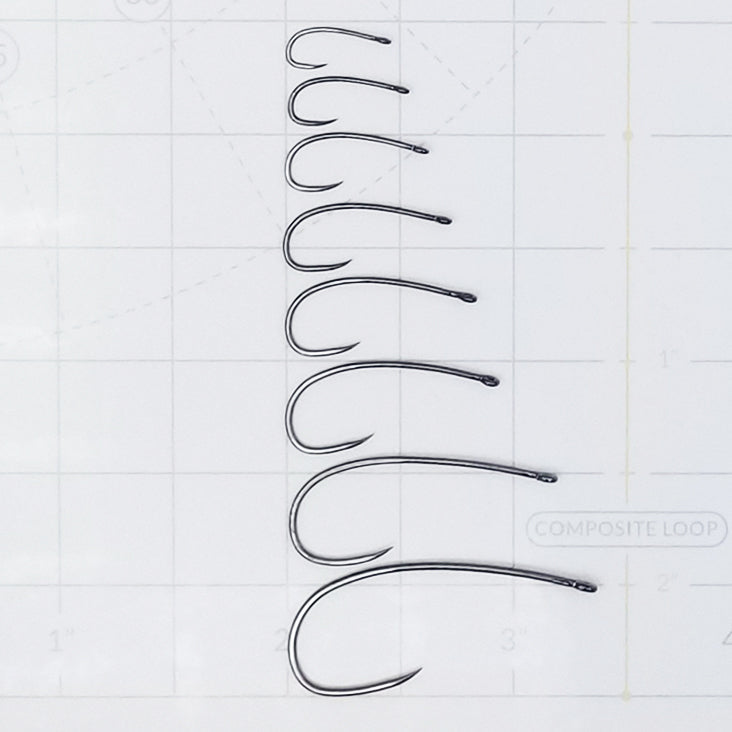
One hook model covers both insects. The 718 runs #4 through #24, so the larger western versions and the smaller eastern ones are the same hook design in different sizes.
Heavy wire, on a dry fly, on purpose. Heavy wire is an unconventional choice for a dry and it costs you buoyancy, so this fly wants enough hair and hackle to carry it, and floatant and the occasional dry-off are part of the deal. What you get back is a stronger hook for aggressive takes, for the heavier tippet this fly is usually fished on, and for appropriately sized dry-dropper rigs carrying a pupa below.
It works for the soft hackle, too. Heavy wire is a compromise on a light-wire dry hook and an asset on a swung wet. Since you want both flies in the box on this hatch, tying them on one hook design is not a bad way to go.
The 718 comes in packs of 36, one size per pack.
The recipe
Freddy Block's October Caddis, as he tied the one in the ad.
- Hook: Firehole Outdoors Sticks 718, #12
- Abdomen: Nature's Spirit Hare's Mask Dubbing (Rusty Spinner)
- Wings: Hareline Elk Hair (Natural)
- Hackle: Whiting Farms Hebert Miner Dry Fly Hackle Rooster Saddle (Furnace)
- Antennae: Whiting Farms CDL cape rachis
- Collar: Hareline Peacock Eyed Sticks (Natural)
- Thread: UTC 70 (Burnt Orange)
Two of Freddy's choices are worth pausing on, because they are most of what separates this from a stock elk hair caddis. He uses a peacock-herl collar rather than another turn of hackle, putting a dark, iridescent band directly behind the eye. And the antennae are the stripped central shaft of a Coq de León feather, stiff enough to hold their shape and translucent enough to catch light. On a natural those antennae are long and obvious, and most tyers leave them off entirely.
A third choice worth noticing is the burnt orange thread. Under the hare's-mask abdomen, it keeps a warm cast showing through where the dubbing thins out.
On color
Most of the recognizable October caddis patterns lean on orange, and for good reason. But there are effective tan, brown, and more subdued versions, and the naturals are not uniformly bright.
The wing is where tied flies take the most liberty. Natural wings vary, but they generally run mottled tan to brown and are often darker than the blonde elk hair many of us reach for. That is a deliberate trade. A big dry skated across broken water at dusk has to be visible to you, and a pale wing is often the only thing keeping it findable in the last twenty minutes of light. Tie one or two with a darker wing for flat water where a fish gets a long look.
Sources and further reading
The behavior described above, particularly the difference in egg-laying between the two groups, comes from published entomology rather than angling lore. If you want to check it or go deeper:
- Troutnut: Dicosmoecus, the western October caddis. Size, coloration, emergence, and ovipositing behaviour.
- Troutnut: Pycnopsyche, the eastern and midwestern Great Autumn Brown Sedge.
- Troutnut: Pycnopsyche guttifera, the most abundant eastern species, and the source for the record of females crawling underwater to deposit eggs.
Putting it together
Tie #6 to #10 if you fish the West. Start with #10 to #12 in the East and keep a few #14s for smaller local insects. Some bright enough to track, one or two with a darker wing. Tie an orange soft hackle in the same range while you are at it, and a weighted larva for the weeks before anything shows on top.
Then work the margins, go late, and give the dry a twitch.
Every Firehole Stick is chemically sharpened and manufactured barbless. Barbless by design: no barb to pinch down, no risk of damaging the point or finish in the process, and an easier release on the water.

1 comment
Scott Harkness
Congrats on the ad! Maybe the next one should feature your great beads!Keep up the great work!🎣
Leave a comment
All comments are moderated before being published.
This site is protected by hCaptcha and the hCaptcha Privacy Policy and Terms of Service apply.