
Some bags say 97%. Some say 95%. Plenty say nothing at all.
It is a reasonable thing to wonder about, because tungsten is the whole reason you are paying more than you would for brass. So here is what the number means, and what it is actually worth once the bead is on a hook.
They are not pure tungsten, and that is deliberate
Tungsten beads are made from tungsten heavy alloy: tungsten powder sintered together with a few percent of nickel and iron.
The binder is not filler and it is not cost-cutting. Pure tungsten is brittle at room temperature and difficult to work, so the small amount of nickel and iron is what turns tungsten powder into something that holds a bore, takes a slot and does not chip in the tray. It is added to make the bead usable.
The trade is density. Pure tungsten is 19.25 grams per cubic centimetre. Add a binder and you give a little of that back.
What each grade is worth
Tungsten heavy alloy comes in standard grades, and they are dense in a predictable way.
| Tungsten content | Density |
|---|---|
| 90% | 17.0 g/cm³ |
| 92.5% | 17.5 g/cm³ |
| 95% (Firehole Stones) | 18.0 g/cm³ |
| 97% | 18.5 g/cm³ |
| Pure tungsten | 19.25 g/cm³ |
Most fly tying beads sit somewhere in that 90 to 97 band. Ours run 95%, about 18 g/cm³, which is roughly 1.6 times the density of lead.
Now the part nobody tells you
Take a 3.0mm slotted bead. Ours weighs 0.21 grams.
Built at 90% instead, the same bead would weigh about 0.20. At 97%, about 0.22. If you could somehow get one made of pure tungsten, about 0.22.
So the entire span from the cheapest alloy on the market to theoretically pure metal is worth about two hundredths of a gram on that bead.
Going up one bead size, 3.0mm to 3.5mm, adds twelve hundredths.
Size moves weight about six times harder than purity does. If a fly is not getting down, the answer is almost never a purer bead. It is a bigger one, or a Tear Drop behind it.
How to check any bead yourself
You do not have to take anyone's word for it, including ours.
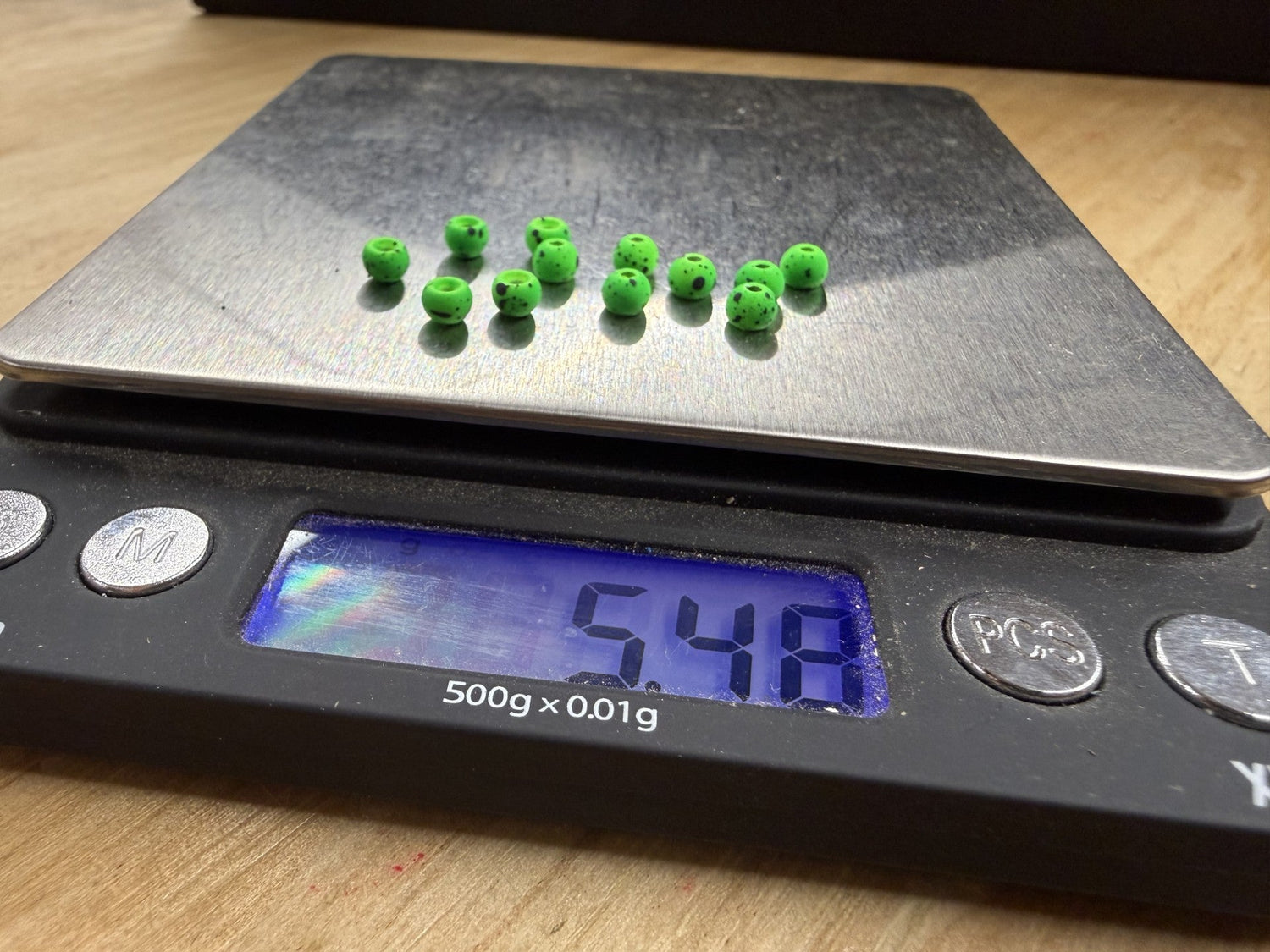
Weigh a known count of beads on a scale that reads to a hundredth of a gram. Then drop the same beads into a graduated cylinder with a known volume of water and read how far the water rises. Mass divided by volume displaced is your density. Compare it against the table above.
Two things will skew it. Air bubbles clinging to the beads inflate the volume and drag your answer down, so tap the cylinder and let it settle. And plating is a different metal from what is underneath, so a heavily plated bead reads slightly off from its own core. Neither is large, but both are why a careful measurement and a spec sheet rarely land on exactly the same number.
What we would rather you judged us on
Two hundredths of a gram is not what makes a bead good.
What makes a bead good is that the bore is clean so thread does not fray going through it. That the slot is cut to actually seat on a jig hook without wobble. That a 2.5mm bead weighs what a 2.5mm bead weighed the last time you bought a pack, and the one before that. That the color on the outside is still there after a season in a tray.
Those are harder to put on a bag than a percentage. They are also the things you notice at the vise.
If you want the numbers for every bead, band and body we make, they are in The Stone Stack.
~John

Leave a comment
All comments are moderated before being published.
This site is protected by hCaptcha and the hCaptcha Privacy Policy and Terms of Service apply.