
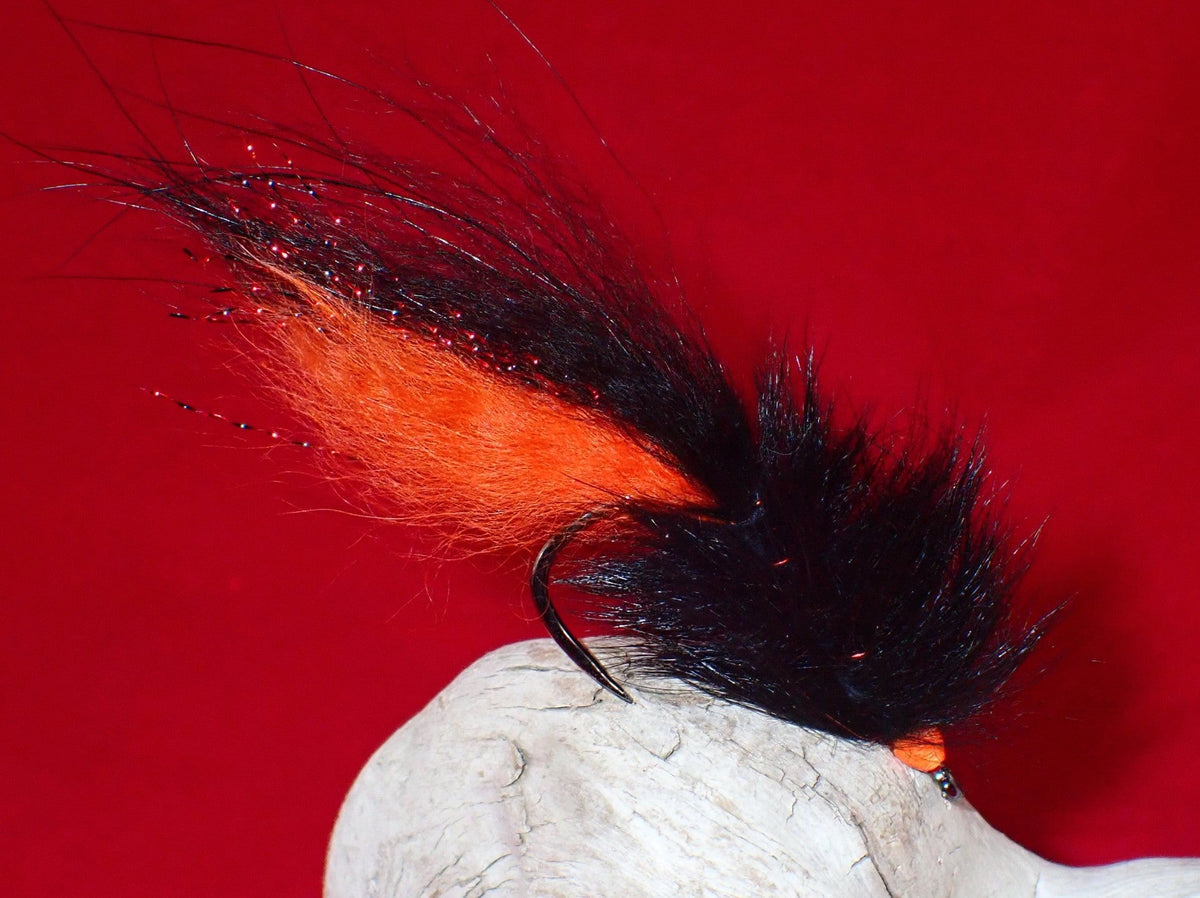
Mike Cline ties in Bozeman and fishes the rivers of southwest Montana, and a decade ago he watched a nice brown trout on a meadow reach cough up a mouthful of fat leeches. The Pine Squirrel Bugger came out of that moment. It has been in his box ever since, and it has caught fish on every river he fishes and on the big meadow water inside Yellowstone.
He sent it to us in October, written up in his own words. His recipe and tying notes are below. Around them is what we think makes this fly worth a permanent slot.
One fly, three foods
Mike describes it as "a versatile streamer representing a leech, sculpin or large salmon fly nymph." That reads like a hedge. It is actually the whole argument for the fly, because those three foods have something in common that most of what a trout eats does not.
They are in the river all year, and they live near the bottom.
Leeches are a year-round food. They are common in rivers as well as lakes, they swim with a slow, rhythmic undulation, and they come in the same dark range this fly is tied in: black, brown, olive, rust.
Sculpins have no swim bladder, so they spend their lives on the bottom, hopping between rocks rather than swimming in open water. In western Montana rivers they are a staple for big trout, and a large one is a serious meal.
Salmonfly nymphs (Pteronarcys californica) spend roughly three years or more in the river before they hatch. So at any time of year there are big, dark nymphs, the largest up to two inches, living among the cobble, long before and long after the adults hatch. They drift a good deal before emerging, which is when trout see them most.
Put those together and you have a fly for the months when nothing is hatching and the river looks empty. A dark, pulsing silhouette, fished down where those three animals actually live.
How Mike fishes it
His instruction is short and it matters: "It is unweighted and intended to be fished on long sinks tips and short (3-4'), stout (0X) tippets."
That is a deliberate choice, and it is worth understanding before you add a bead out of habit. On a sink tip the line does the sinking. An unweighted fly on a short leader rides at the depth of the line and swims level behind it, so the fur breathes as it moves instead of diving nose-first. A heavy fly on a long leader hinges and drops. A light fly on a short leader swims.
The stout tippet earns its place too. This is a big fly fished deep for big fish, and a 0X tippet lets you put pressure on a good brown without guessing.
Why the 811
Mike ties the flies in his photos on a #4 Firehole Sticks 811. Here is what that hook is doing.
The length carries the tail tie-in. The 811 is a 3XL streamer hook. Mike secures the tail butts "along the hook shank to about 1/8" behind the hook eye," which builds an even underbody for the pine squirrel to wrap over. A long shank is what gives that base its length, and what gives the fly its leech-and-sculpin proportions.
The 2XG gap keeps the point clear. Wrapped pine squirrel is dense, and it stands up off the shank. The extra gap on the Firehole Sticks 811 lets the fur sit behind the point instead of shrouding it when a fish takes the fly from the side.
Heavy wire and a straight eye. The heavy wire holds a big trout in current, and it adds a little weight to an otherwise unweighted fly without changing how it swims. The straight eye keeps the fly tracking in line on a short, stiff tippet.
Mike's recipe calls for #2 through #6. The 811 runs #1 through #10. Packs of 28, one size per pack.
The recipe
Mike Cline's recipe and notes.
Pine Squirrel Bugger
Materials:
- Hook: #2 - #6 Firehole 811 barbless streamer hook (#4 pictured)
- Thread: UTC 140 or equivalent.
- Tailing: Finn Raccoon fur or Arctic Fox fur. Finn Raccoon is preferred as it is more supple with long under fur and longer guard hairs.
- Flash: Any suitable flash material such as Polar Flash or Crystal Flash. Silicon legs can be used for flash as well as they add additional movement to the tailing.
- Body: Zonked N. American Pine Squirrel or Euro Pine Squirrel. Euro Pine Squirrel has slightly longer hair than the N. American squirrels and works well with larger hook sizes.
- Rib: UTC BR or Med wire
Tying it
Create the tail by layering two different colors of Finn Raccoon dark over light interlaced with a bit of flash. The tail should be about the same length as the hook with the butts secured along the hook shank to about 1/8" behind the hook eye. This provides a good base for the zonked pine squirrel.
Once the wire ribbing is tied in at the hook bend, attach the pine squirrel strip skin side up with the hair facing backwards. Wrap the pine squirrel strip over the tie in point and then forward around the hook shank while continually using your fingers to hold the fur backwards. The edges should not overlap. The zonked fur strip may stretch a bit and should be wrapped tautly around the hook shank. Secure and clip at the hook eye. Counter wrap the wire ribbing and secure the head with a whip finish or double half hitches.
Mike adds: "It can be tied with just about any color combination depending on availability of material." The two in his photos are his Black Pine Squirrel Bugger and a natural one tied with Euro pine squirrel.

Natural Pine Squirrel Bugger in Euro pine squirrel on an 811. Photo by Mike Cline.
Why pine squirrel and not rabbit
Most buggers and leeches with a wrapped fur body use rabbit. Mike's choice of pine squirrel is the quiet detail in this fly.
Pine squirrel is cut from a thin, supple hide and carries short, dense fur. Wrapped, it pulses close to the hook and gives a compact profile that breathes rather than billows. Rabbit is longer and softer and swims bigger. For a fly meant to read as a leech or a sculpin hugging the bottom, compact is the point.
Mike's note on Euro versus North American squirrel is worth taking literally: the Euro hair is a little longer, so it suits the #2 and #4, while North American squirrel keeps a #6 in proportion.
Counter-wrapping the wire rib, as he does, locks the hide down so the fly survives more than a few fish.
Putting it together
Tie three. A black #4 and a natural Euro squirrel #4, the two Mike sent, and a #6 in North American squirrel for lower, clearer water. Fish them on a sink tip with three or four feet of 0X, in the deep runs and seams of a meadow river, in the months when the surface is quiet.
Pine squirrel keeps moving even when the fly does not.
Firehole Sticks 811, sizes #1 through #10. Manufactured barbless, so a big brown that ate a two-inch streamer comes off quickly and goes back strong, with no pliers at the side of the river.
Thank you to Mike for this one.
~John
Sources
Every source below was opened and read for this piece.
- Mike Cline, "Pine Squirrel Bugger," sent to Firehole, 10 October 2026. Pattern, recipe and photos.
- Fly Fisherman, "Fishing Leech Flies." Leeches in rivers and lakes, swimming action, year-round availability, color range.
- Fly Anglers Online, "Leeches" (FAOL archive). Leeches as a year-round food, rhythmic swimming.
- Alaska Department of Fish and Game, "Slimy Sculpin." Bottom-dwelling, no swim bladder, hopping movement.
- Missoulian Angler, "Sculpin." No swim bladder, forage for trout in western Montana rivers.
- Troutnut, "Pteronarcys californica (Giant Salmonfly)." Three-year nymph development, size, cobble habitat, drift before emergence.
- Wikipedia, "Pteronarcys californica." Nymph lifespan of three to four years, length over two inches.
- Feather-Craft, "The Underrated Workhorse: Pine Squirrel." Pine squirrel hide, fur length and profile against rabbit.

Leave a comment
All comments are moderated before being published.
This site is protected by hCaptcha and the hCaptcha Privacy Policy and Terms of Service apply.