
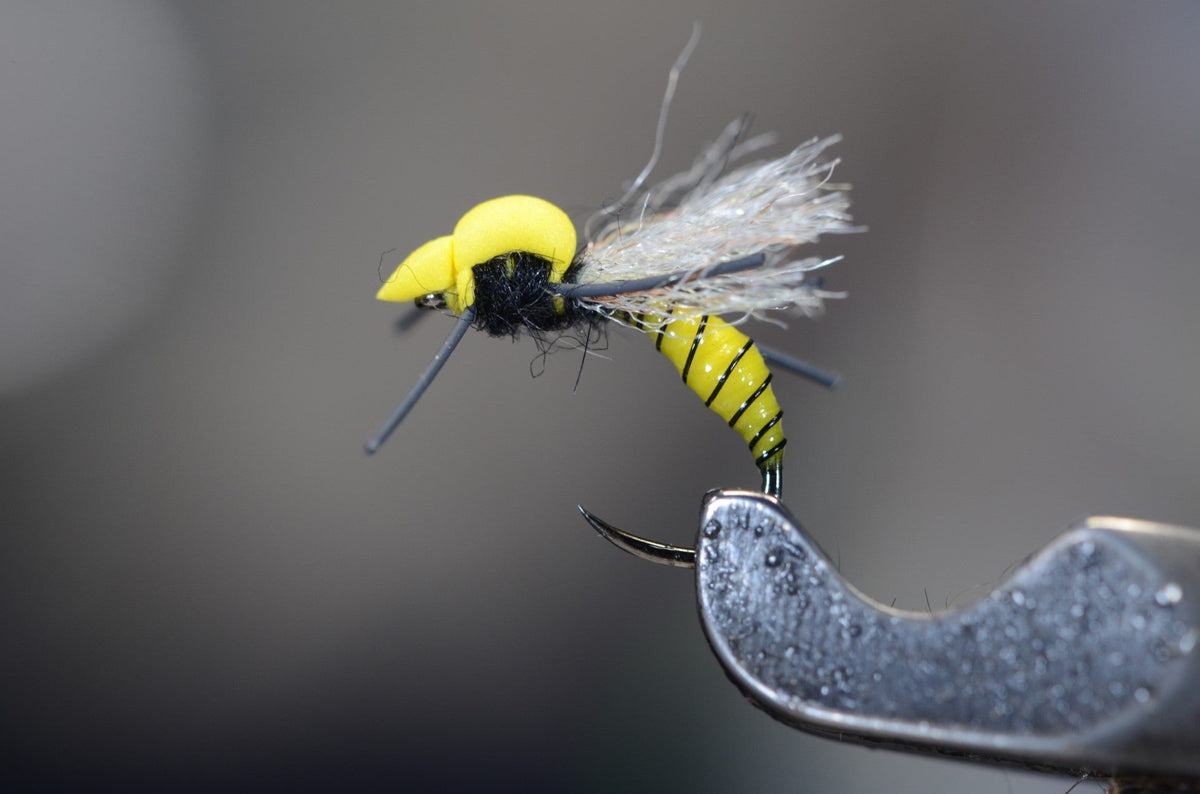
Photo by Rich Strolis
Where this one came from
Rich Strolis tied a bee on our 315 and put the video up on Catching Shadows on 10 September 2026. He calls it the Buzz Viper, and he describes it as a semi sunk bee pattern, which is the most useful three words anyone has written about this fly. It is built to hang in the surface film rather than sit on top of it, in sizes from 14 up to a whopping #8 for the bumblebees.
His reasoning for the under-film design is worth quoting directly, because it is the whole fly: “Like my ants, I prefer mine to ride under the film as most of the deceased naturals do the same from my observations as they too get swamped and hang under the film in the same manner as an ant.”
That observation turns out to be better supported than a preference has any right to be.
What trout actually eat when they eat terrestrials
Ask a fly angler to name a terrestrial and you get a hopper. That answer is right for some water and wrong for most of it, and which one it is depends on what is growing on the bank.
In a study of brown trout in a boreal forest stream, Hymenoptera, the order that holds ants, bees and wasps, made up 37% of the terrestrial drift organisms the trout ate. Diptera came second at 27%, beetles third at 19%, spiders at 7.5%.
Read that number for what it is. That is a forest stream. Grasshoppers barely enter the picture there, and the reason is not that the trout turned them down. It is that hoppers live in open grass and there were very few of them over a closed canopy to fall in. A drift study can only measure what the bank hands the water.
Which points at the rule, and the rule is more useful than a league table. Riparian land use changes both how much terrestrial material reaches a stream and what kind it is. Fish a hay field, a pasture edge, an agricultural bottom or an open grassy corridor in August and the hopper is exactly right, because that is the bank feeding the drift. Fish under a canopy, which is most trout water in the Northeast, and what comes down is ants, bees, wasps, beetles and caterpillars.
Rich gets to the same place from the bank rather than the literature. Hoppers, he writes, “aren’t quite as much of a thing for us here in the Northeast as they are out west or down south, but they do have their moments.”
And under that canopy the bee is not a consolation prize. Work on rainbow trout in two Patagonian streams found Hymenoptera among the terrestrial prey the trout positively selected, taking them at a higher rate than their share of what was drifting past. The fish were not settling for ants and wasps because nothing better came by. They were picking them out.
So the question was never hopper or bee. It is what is growing above the water you are standing in, and most of us are standing under trees.
The behaviour that puts them in the water
Here is the part that makes late summer specifically a bee and wasp window, and it is two separate mechanisms running at once.
Honeybees are at the water because of the heat, and some of them do not leave. A colony holds its brood nest between roughly 90 and 97°F, and it does that in hot weather by collecting water, spreading it on the combs and fanning. Bees cannot store water the way they store nectar and pollen, so it has to be fetched continuously. As temperatures climb, more of the colony’s foragers are redirected onto water. Extension guidance on helping bees through a heat wave is specific about the consequence: put pebbles in the water you set out, because without footing the workers drown.
Which is to say that in the hottest stretch of the year, more bees are flying to water than at any other time, and a share of them end up swamped. That is not an accident of wind. That is the mechanism, and it runs hardest exactly when the trout have run short of aquatic bugs.
Wasps peak on a different clock. Yellowjacket colonies build through the summer to somewhere between 1,500 and 15,000 individuals depending on species. By late summer the colony slows or stops growing and needs large amounts of sugar, and the foragers turn to sweet things and then to outright scavenging. More wasps, hungrier wasps, ranging further and lower, at the exact turn of the season when the water is low and clear.
So the honeybee is over the water for thermoregulation and the wasp is over it looking for sugar, and both are most numerous in the weeks when a trout has the least else to eat.
Timing
Late summer through the first cool weeks of fall. Mid-day rather than the edges, which inverts the usual advice and is the point: this is a fly for the flat, bright, unpromising hours when nothing is hatching and the fish are looking up anyway for whatever falls in.
Rich is honest that the odds sit with the trout in this window. Low, clear water, fish that have seen every parachute Adams in the county, and a refusal rate that can run higher than the eat rate. Fewer fish, often better ones.
The primary presentation
Dead drift, in the film, fished like an ant. The foam front holds the thorax up and the rest of the fly hangs down into the surface, which is the posture of a drowned bee rather than a landing one.
When it fails: when you actually watch a live bee hit the water. A fresh bee struggles on the surface and rides high, and a sunk-abdomen fly is the wrong silhouette for that. Rich makes the point himself and it is worth repeating: do not throw out the high-floating all-foam versions. They cover the other half of the situation.
Two profiles, one insect. Carry both if you fish bee water seriously.
The companion fly
The ant, and Rich’s framing makes the pairing obvious, since he ties the bee to fish the same way. An ant and a bee cover the same feeding behaviour at two sizes and two silhouettes, and the fish that refuses one will frequently take the other on the next drift.
Beetles belong in the same box for the same reason.
Sizes and colour, which matter more here than usual
Most terrestrials give you a narrow useful size range. This one does not. Rich carries 14 through 8, calls #12 his go-to because it reads as either a honeybee or a wasp, and keeps the #8 for the bumblebees that end up in the wash.
Two colour schemes cover it: yellow and black for the honeybee and yellowjacket, brown for the wasps. That is a four-fly matrix at most, which is a small commitment for a window this long.
Why the 315
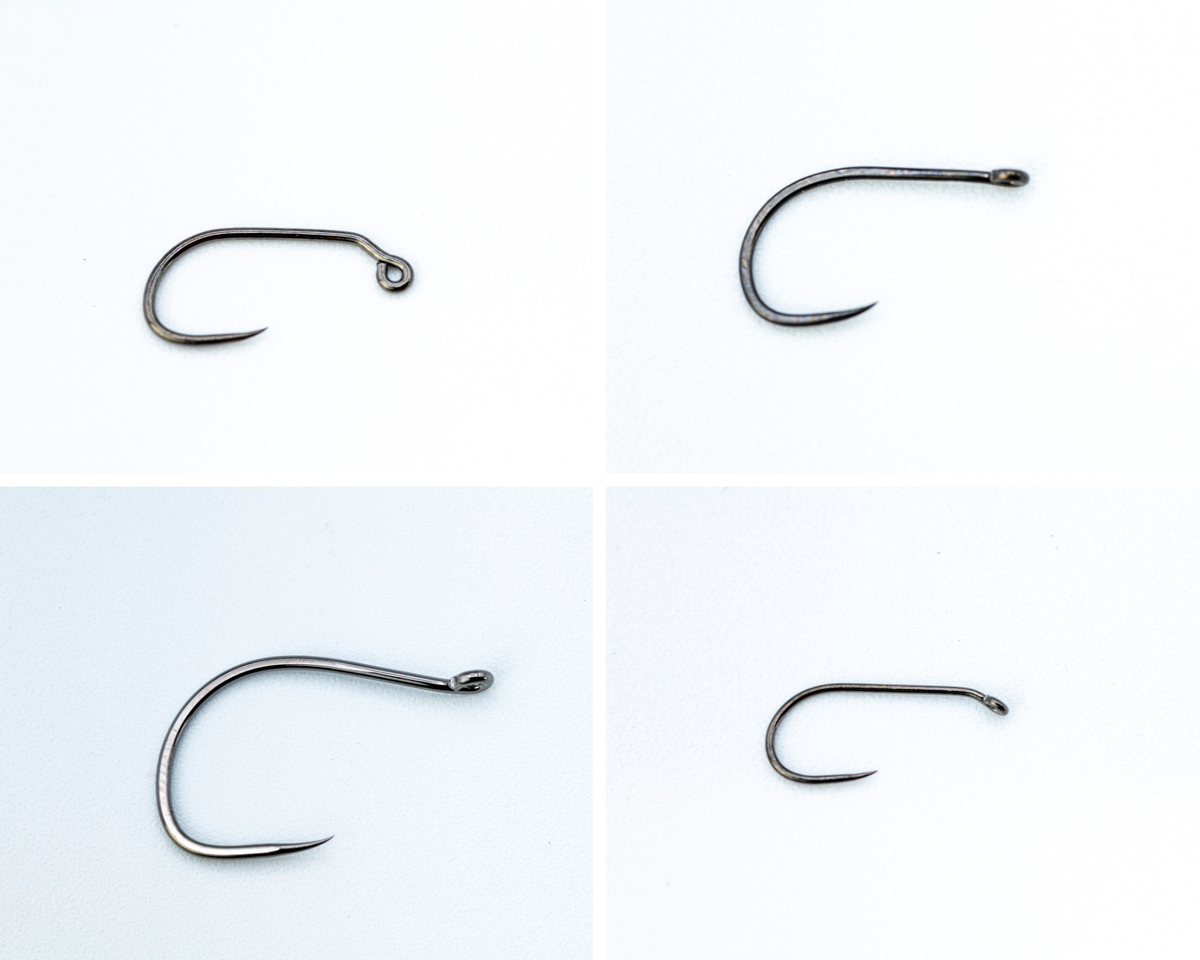
The Buzz Viper is a fly with a deliberate fight built into it. The foam cylinder at the front wants to float. The fly is supposed to hang. Something has to win the back half of that argument, and the hook is what does it.
Heavy wire sinks the abdomen. The Firehole Sticks 315 runs heavy wire for its length: 0.68 mm at #12 on a 13.2 mm hook, 0.81 mm at #8. The foam holds the thorax in the film and the wire carries the rest of the fly down into it. That is the posture Rich designed the fly around, and it is the hook doing half the work.
If you tie this on a lighter-wire curved hook, it will ride higher than Rich intended. That is the wire, not your tying.
The 2XG gap keeps the point clear under a crowded front end. A 3/16″ foam cylinder plus dubbing plus rubber legs is a lot of material stacked at the eye. At #12 the 315 opens 9.3 mm, at #8 it opens 12.5 mm. The extra gape is what stops a bulky thorax from shrouding the point on a fish that eats the fly sideways, which in the film is most of them.
The deep continuous bend gives the abdomen its shape. A swamped bee hangs with a segmented abdomen curving down and away. The 315’s bend is the body shape before a single wrap goes on, and there is room to run Uni Stretch and a wire rib around it without crowding the gap.
Sizes run 6 through 22, so Rich’s 14 to 8 sits in the middle of the range with room either side. Packs of 36, one size per pack.
The recipe
Rich’s words and his material spellings, as published.
Buzz Viper
- Hook: Curved Emerger, Firehole 315, Daiichi 1167, TMC 2487 size 14-8
- Thread: 8/0-6/0 black, yellow or brown
- Rear end: Yellow or brown Uni Stretch
- Rib: Black or Amber medium wire
- Wings: Sparkle Emerger Yarn or EP Trigger Point
- Front end: Foam Cylinder 3/16″
- Dubbing: MFC Special Sauce Caddis Black or Caddis Variant
- Legs: Fine or Medium Rubber or Barred Sexi Floss
Video by Rich Strolis. The full write-up, and the rest of his work, is at Catching Shadows →
A note on the materials
Two choices in that list are doing more than they look like they are.
Uni Stretch for the rear end, not dubbing. It lays down a smooth, tight, slightly translucent abdomen that takes a wire rib cleanly and, importantly, adds almost nothing in the way of floatation or water-holding bulk. The back of this fly is supposed to be dense. Dubbing would fight that.
Foam only at the front. The all-foam bee is a different fly for a different moment. Restricting the foam to a 3/16″ cylinder at the thorax is what creates the hinge: buoyant at one end, dense at the other, hanging at the angle a drowned insect hangs at.
The wire rib earns its place twice, as segmentation and as a little more weight in the abdomen.
Sources
- Eloranta, A. et al., “Forest-Stream Linkages: Effects of Terrestrial Invertebrate Input and Light on Diet and Growth of Brown Trout,” PLOS ONE.
- “Selective foraging by non-native rainbow trout on invertebrates in Patagonian streams in Argentina,” Zoological Studies.
- “Effect of riparian land use on contributions of terrestrial invertebrates to streams,” Hydrobiologia.
- Connecticut Beekeepers Association, “Water Foraging by Honey Bees.”
- Oregon State University Extension, “How to help bees survive a heat wave.”
- UC Statewide IPM Program, “Yellowjackets and Other Social Wasps.”
- Rich Strolis, “Buzz Viper Bee Pattern,” Catching Shadows, 10 September 2026.
Putting it together
Tie four. A #12 in yellow and black, a #12 in brown, a #14 in yellow and black for the flat days, and one #8 for the bumblebee that lands where a good fish can see it. Add an ant in the same sizes if the box does not already have one.
Then fish them in the hours you would normally skip, and on the water where the bank is trees rather than grass. Low clear water at mid-day in September is not a hatch window and it is not supposed to be. It is a window for a fish eating extras, and under a canopy the extras are Hymenoptera. Keep the hoppers for the meadow stretches. They earn their place there.
Firehole Sticks 315, sizes 6 through 22. Manufactured barbless, so the fly comes out of a good fish in warm September water without you working at it with pliers.

1 comment
Jon
My fly boxes are filled with nymphs. Many of the boxes are packed with Euro nymphs.
It wasn’t always this way. It began a few years ago when we were hit by the tail end of two tropical storms. Flooding insured on all streams in the area. For a couple of years there were no hatches to speak of. My solution was to concentrate on bottom crawlers such as scuds and cress bugs. I was surprised how many how many fish I caught. Now I missed the dry fly fishing but there were no bugs hatching. So, I either stayed home or I switched targets. I became more adept at catching trout on nymphs than I thought possible. A door slams closed and a window opens. Also, I had a lot fewer fisherman to contend with.
Leave a comment
All comments are moderated before being published.
This site is protected by hCaptcha and the hCaptcha Privacy Policy and Terms of Service apply.