
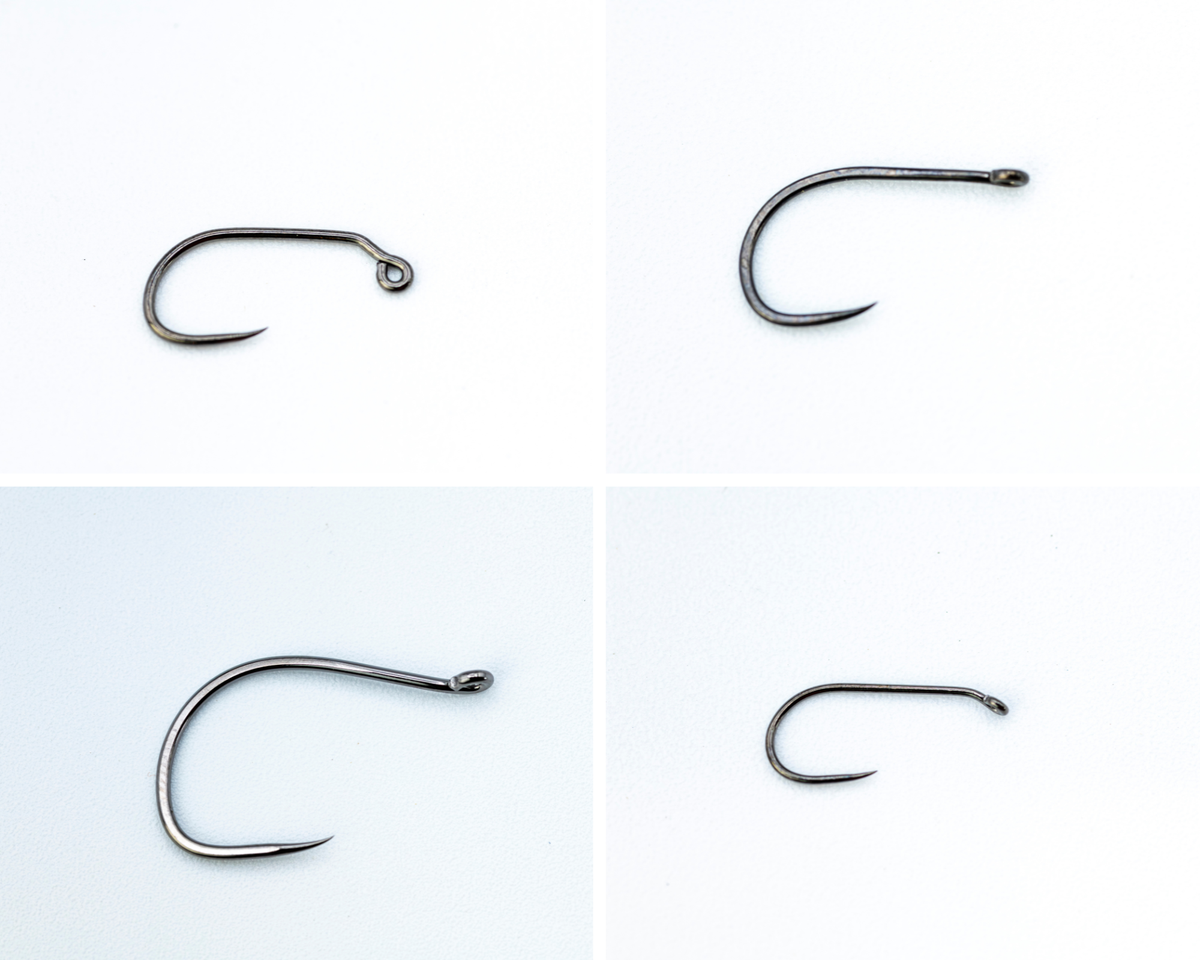
Look at the front of a fly hook and you will usually find one of a few basic designs: the eye points straight ahead, turns down, turns up, or sits on an angled section of wire.
Those differences are easy to see. What they actually do is less obvious.
The hook eye is where your leader connects to the hook, but its orientation also affects the hook's tying space and overall geometry. Some eye styles exist for very practical reasons. Others are tied to traditions that go back generations. Here is what matters at the vise.
Straight eye
A straight eye continues in roughly the same plane as the hook shank. Viewed from the side, there is little or no upward or downward turn at the front of the hook. It is simple, clean geometry.
A straight eye leaves the front of the shank relatively unobstructed, which can be useful when materials need to be tied close to the eye. You will find straight eyes on streamers, saltwater and predator hooks, and nymphs. On Firehole, the 612 is a straight-eye nymph hook.
The important point is that straight eye describes the eye, not what the hook is for. Bend, gape, shank length, and wire still tell you much more about how the hook was designed to be used.
Down eye
A down-eye hook turns the eye below the plane of the shank.
This is probably the eye style most fly tyers recognize. Down eyes are common across traditional dry-fly, wet-fly, and nymph hooks, and generations of familiar patterns have been tied on them. On a dry fly, the downturned eye also sets the tippet a little lower, toward the surface film, which some tyers prefer.
The turn does consume a little space below the front of the shank, which can matter when you crowd the eye with materials. Anyone who has finished a fly only to discover there is barely enough room left to get the tippet through knows the problem.
That is mostly a tying problem, not an argument against down-eye hooks. Leave yourself room when building the head and the eye does its job just fine.
Up eye
An up-eye hook turns in the opposite direction, placing the eye above the plane of the shank.
Up eyes show up most on classic and traditional patterns: salmon and steelhead flies, spey and swung wet flies, soft hackles, and some small dries. They remain useful where the pattern or hook geometry calls for them.
You will sometimes hear claims that an up eye or down eye inherently changes how effectively a fly hooks a fish. Be careful with those rules. A hook is a system: point position, gape, bend, wire, leader connection, fly construction, and the pressure applied by the angler all interact.
Eye direction alone doesn't tell you whether a hook will fish well.
Jig hooks
A jig hook is different.
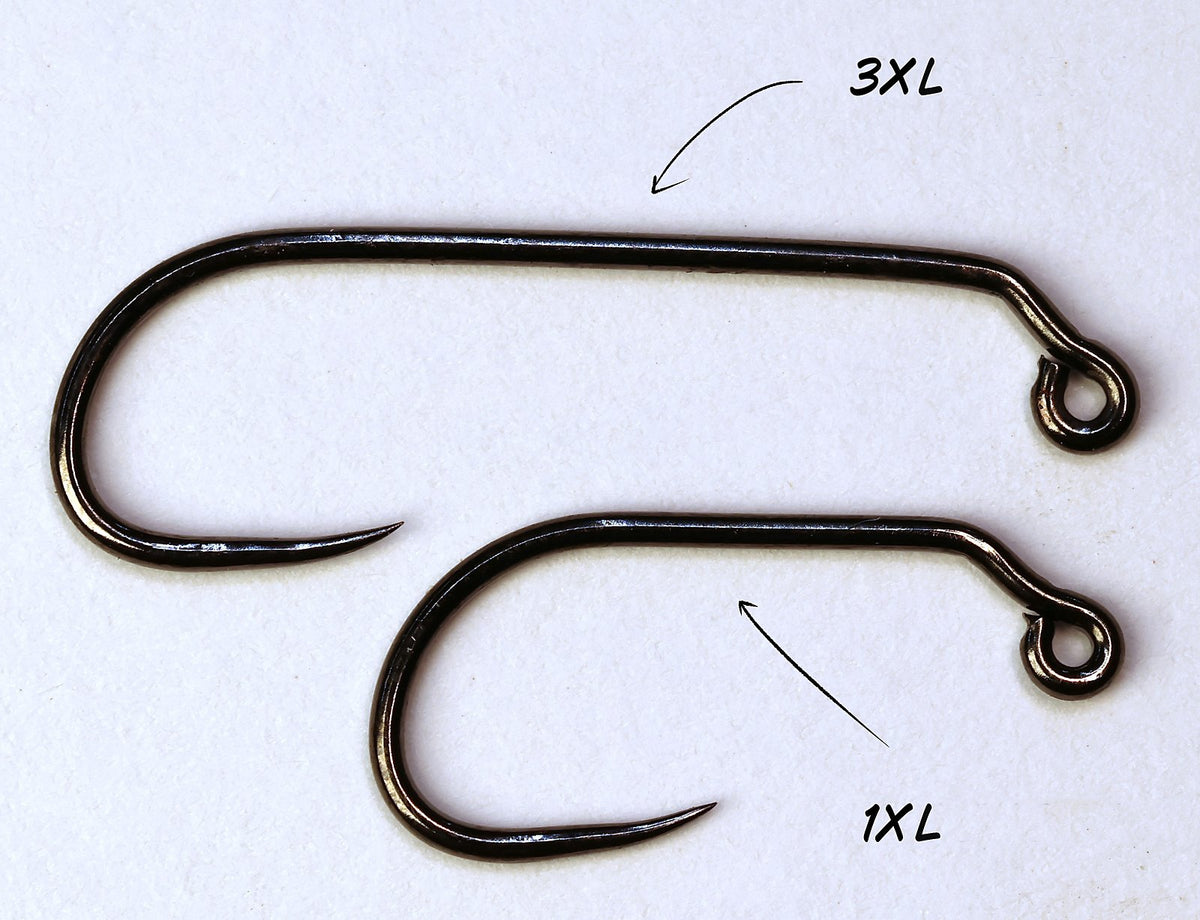
Instead of simply turning the eye at the end of an otherwise straight shank, the front section of a jig hook is bent, commonly to 60 degrees, so the eye sits away from the main axis of the shank. Sixty degrees is the usual angle for fly-tying jig hooks. A steeper 90-degree bend exists too, more often on streamer and classic vertical-jig designs. Firehole's jig hooks include the 516, 520, and 535, along with the 511, a 90-degree jig streamer.
That geometry creates room for a slotted bead to move around the bend and seat farther back on the hook. Combined with the weight of a tungsten or brass bead, it can also influence how the finished fly rides in the water.
This is why jig hooks and slotted beads are usually treated as a system. The hook geometry makes the bead position possible. The bead provides the weight that determines much of how the finished fly behaves.
Not every jig hook is the same. Eye angle, shank length, bend, gape, and bead size can all change the finished fly.
Does eye direction change how a fly rides?
Sometimes, but be careful about giving the eye too much credit.
The orientation of a finished fly in the water is the result of several things working together: hook geometry, weight distribution, bead position and weight, tying materials, current, leader tension, and the location of the line connection.
On an unweighted conventional hook, simply changing from a down eye to a straight eye does not guarantee that the fly will ride differently in some predictable way.
With a jig hook and a weighted bead, the geometry and weight distribution are much more consequential. That is the combination responsible for the familiar point-up orientation associated with many jig-style nymphs.
The useful question isn't, "Which eye fishes best?" It is, "Why is the eye positioned this way on this particular hook?"
Eye size matters too
Direction isn't the only thing to look at.
The physical size of the eye determines how much room you have for tippet, and that becomes especially noticeable at the extremes.
On a small hook, an oversized eye can look out of proportion and interfere with the fly. Make it too small and threading fine tippet becomes unnecessarily difficult. On heavier hooks intended for larger flies and stronger leaders, the eye needs enough opening for the leader material the hook is likely to encounter.
Like gape, wire, and shank length, eye size is part of the overall design.
What about the shape of the eye?
Most fly hooks use a ring eye, where the wire is formed into a round or nearly round loop. But you may also encounter tapered, looped, or specialty eyes on certain traditional and modern hook designs. Tapered eyes, for instance, were traditionally used to reduce weight and bulk on delicate dry flies.
For most fly tyers, eye orientation is the more useful distinction. The specialized eye styles become important when you get into particular techniques and traditional hook designs.
How to choose
Don't choose a hook because it has a straight eye, down eye, or up eye. Choose the hook geometry that fits the fly.
Start with the shank length, gape, bend, and wire you need. Then look at the eye and ask whether its orientation gives you the tying space and leader connection that make sense for the pattern.
Jig hooks are the major exception, because the angled front section is fundamental to what that hook is designed to do, particularly when paired with a slotted bead.
The eye is one part of the hook. Understanding why it is there helps you understand the rest of the design.
New to the line? Start with choosing a Firehole hook, learn more about hook sizes, or browse the full Firehole Sticks range.

Leave a comment
All comments are moderated before being published.
This site is protected by hCaptcha and the hCaptcha Privacy Policy and Terms of Service apply.