
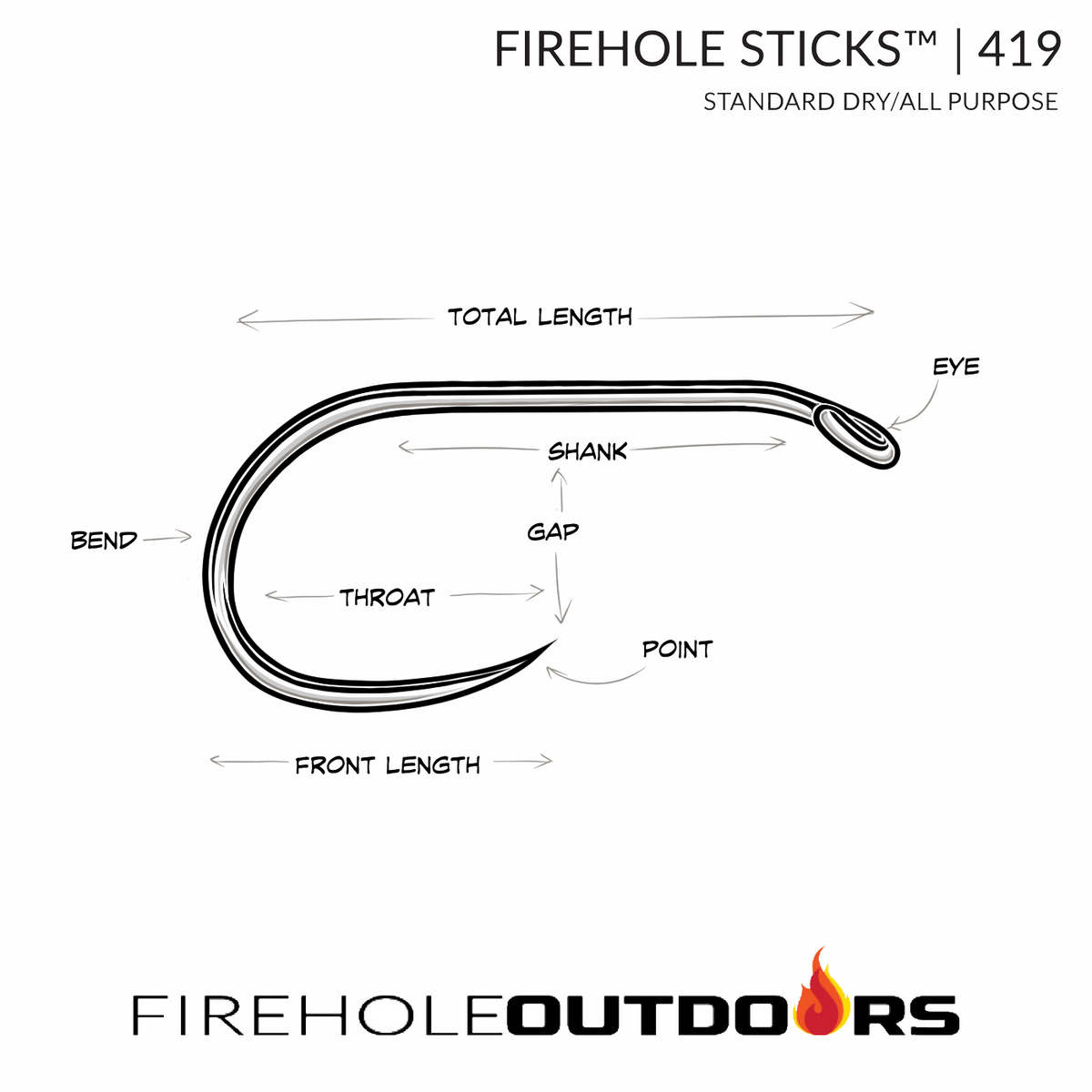
A hook is a handful of parts. Once you can name them, you tie better and you choose better, because the names are the vocabulary behind every other hook decision you make: size, wire, gape, bend. The terms below are the standard ones tyers and hook makers use. Here is each part, and what it actually does at the vise and when a fish eats.
The eye
The loop at the front, where your tippet and your thread start. An eye can turn down, sit straight, or turn up, and that angle changes how the fly rides and how much gape you keep. Eye styles get their own lesson. For now, the eye is the anchor, and a clean, fully closed eye is one mark of a well-made hook.
The shank
The straight run from the eye to where the bend begins. The shank is the backbone of the fly, and its length sets how long a body you can build. The "X" system describes that length: a "2X long" shank is as long as a hook two sizes larger, and a "2X short" shank is as short as one two sizes smaller. A longer shank gives you a longer body without changing the gape.
The bend
Where the shank curves down and around toward the point. There are many named bend shapes, but the ones you meet most are the round (the Model Perfect is one classic form of it), the sproat, the limerick, and the continuous curve. Each changes the fly's profile and the way the hook sits in a jaw. A scud rides a continuous curve. A classic nymph rides a round bend.
The point
The business end. The point is what penetrates, and how fast it penetrates depends on how sharp it is and how much metal sits behind it. A barbless point can go in with less resistance than a barbed one, because there is no barb to push through. That is one part of the case for barbless, and we make the rest of it here.
The barb, or the lack of one
The small backward-facing spur behind the point on most hooks. Every Firehole hook is manufactured barbless, and a barbless hook comes out of a fish faster and cleaner.
The gape
The distance between the point and the shank, also called the gap. This is the measurement that matters most, because hook size is built around it. The gape decides how big a fly the hook can carry and how much of a jaw it can take: too little and a bulky fly crowds the point, too much and the fly looks wrong. On our hooks a wider-than-standard gape is written "2XG" (you will also see it called "2X wide").
A word on "size"
Here is the part the catalogs skip: there is no true industry standard for hook size. Size is traditionally set by the gape, but some makers size by shank length instead, some by both, and the upshot is that a size 14 from one brand is not always a size 14 from another. That is exactly why we publish the real dimensions of every hook, and why our comparison chart matches models by measurement, not by the number stamped on the package.
The throat
Also called the bite. It is the depth of the hook's bite: how far the point can sink toward the bend before the bend stops it, measured from the point to the deepest part of the bend. (Terminology varies between references; some measure the throat from the top of the bend to the gape.) Bite depth is one of the geometry choices that affects how the point seats under tension.
The wire
The gauge, or thickness, of the steel the hook is drawn from. Fine wire keeps a dry fly light; heavy wire adds weight to a nymph and resists bending under a hard-pulling fish. Wire weight runs from fine to standard to heavy, with 2X and 3X heavy for the strongest hooks. It is enough of a subject that it gets its own lesson.
The three measurements we publish
Every Firehole hook is spec'd by three dimensions, and now you can read them:
- Total length: the eye to the bend.
- Gape: the point to the shank, the width.
- Front length: the top of the bend to the tip of the point.
These are how you compare one hook to another honestly, past the marketing. Our comparison chart and dimensions sheet use exactly these three.
Why anatomy matters
Naming the parts is not trivia. It is the language of every hook choice you make. Once you see a hook as an eye, a shank, a bend, a gape, and a point, you stop guessing and start choosing.
Start with our guide to choosing a fly tying hook, or browse the full Firehole Sticks line.

Leave a comment
All comments are moderated before being published.
This site is protected by hCaptcha and the hCaptcha Privacy Policy and Terms of Service apply.