
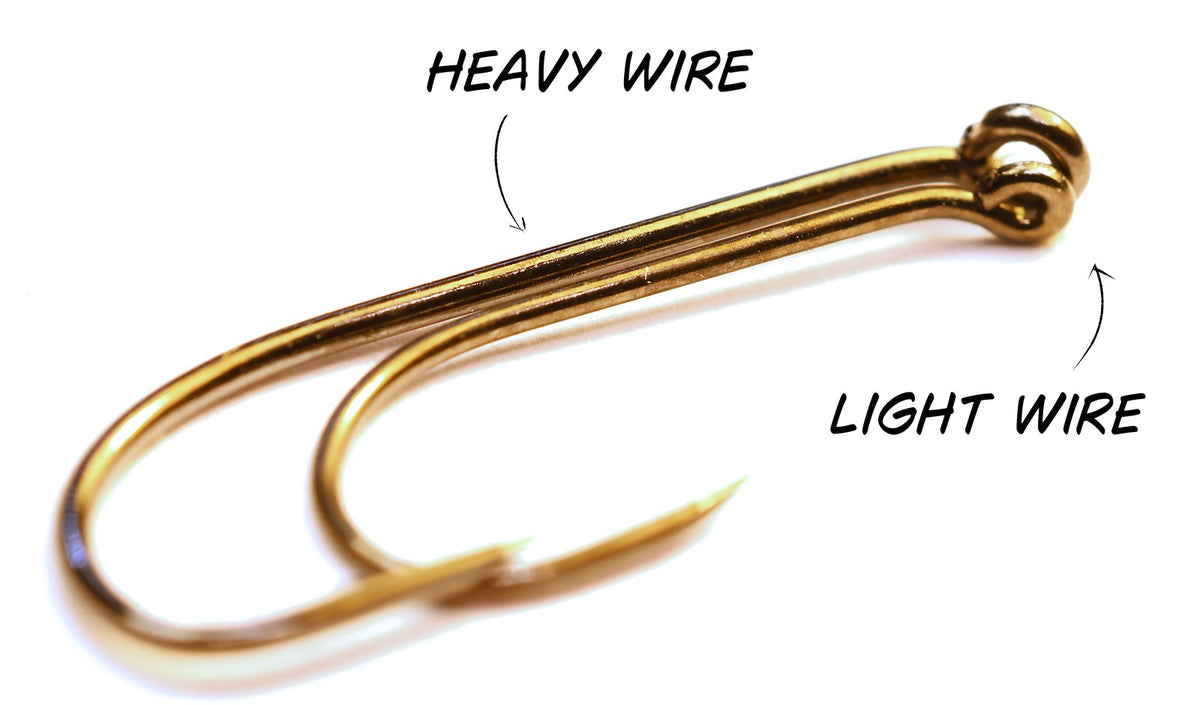
A dry-fly hook and a nymph hook can wear the same size on the package and still fish nothing alike. A lot of that difference is the wire.
Wire weight describes the thickness of the steel used to make a hook. It affects how much the hook weighs, how strongly it resists bending, and how readily the point penetrates. Two hooks with the same basic size and shape can behave very differently simply because one is built from heavier wire.
Wire weight vs. wire diameter
Fly tyers usually talk about wire weight: fine, standard, heavy, 2X heavy. But the physical measurement is wire diameter. A hook made from 0.55 mm wire is literally thicker than one made from 0.45 mm wire. The X designation describes that difference relative to a manufacturer's standard hook. The diameter measures it.

What the wire actually does
Three jobs ride on wire weight, and every choice trades them against each other.
- Weight. Fine wire reduces the hook's mass, which matters especially on dry flies. Heavy wire adds mass and can contribute to getting a subsurface fly down. On a weighted nymph or streamer, beads and added weight may contribute much more, but the hook itself is still part of the equation.
- Resistance to bending. All else being equal, thicker wire is harder to bend or open than thinner wire. But diameter isn't the whole story. Hook geometry, steel, tempering, and manufacturing process all contribute to how a finished hook behaves.
- Penetration. Wire diameter influences penetration because a thicker hook ultimately has to displace more tissue. But the point itself matters enormously. Point length, taper, sharpness, and geometry determine how easily penetration begins. A well-designed heavy-wire hook can therefore penetrate exceptionally well despite having more material behind the point.
Fine, standard, and heavy wire
Those are categories, not universal measurements. Within them you may see specifications such as 1X fine, 2X fine, 1X heavy, or 2X heavy.
- Fine wire. Ideal for dries and delicate presentations where low hook weight matters. Fine wire can also penetrate extremely well, but it gives you less margin against bending when heavy pressure is applied.
- Standard wire. The versatile middle ground. Enough strength for a wide range of fishing without adding unnecessary weight.
- Heavy wire. Useful when strength or additional hook weight matters: powerful fish, heavier tippet, heavy nymphs and streamers, or situations where you expect to put substantial pressure on the hook.
Reading the wire tags
Wire uses the same X system as hook length and gape. 2X heavy (2XH) means heavier wire than the standard for that nominal hook size. 2X fine (2XF) means lighter wire.
Traditionally, each X represents roughly one hook-size step in wire diameter. A size 14 1X-heavy hook might use approximately the wire associated with a standard size 12; 2X-heavy, approximately the wire associated with a size 10. Fine wire moves in the other direction.
But manufacturers don't all interpret those steps identically. Think of the X rating as a useful description of relative wire weight, not an exact measurement.
When the actual wire diameter matters, use the numbers.
Wire and barbless
Going barbless doesn't mean going light. Wire weight and a barb solve different problems. The barb affects how easily a hook can back out. Wire diameter affects weight and contributes to the hook's resistance to bending.
A good barbless hook still needs the right wire for the job, a sharp point, and geometry that keeps the fish connected under tension. That's why we don't treat "barbless" as a substitute for the rest of the hook's design. We make the full case for barbless here.
How to choose
Start with what the fly needs to do. A dry that needs to ride high benefits from fine wire. A nymph that needs additional weight may benefit from heavier wire. If you're expecting larger fish, heavier tippet, or situations where you'll apply substantial pressure, heavier wire may be worth the additional mass.
Don't automatically choose the heaviest hook you can find. Choose enough wire for the job without adding weight you don't need.
That's the tradeoff. Fine wire removes mass and usually improves penetration, but gives up some resistance to bending. Heavy wire adds mass and material, giving you more resistance to bending at the cost of weight. The right choice isn't the heaviest hook you can get away with. It's the lightest wire that still does the job you need it to do.
New to the line? Start with choosing a Firehole hook, or browse the full Firehole Sticks range.

Leave a comment
All comments are moderated before being published.
This site is protected by hCaptcha and the hCaptcha Privacy Policy and Terms of Service apply.