
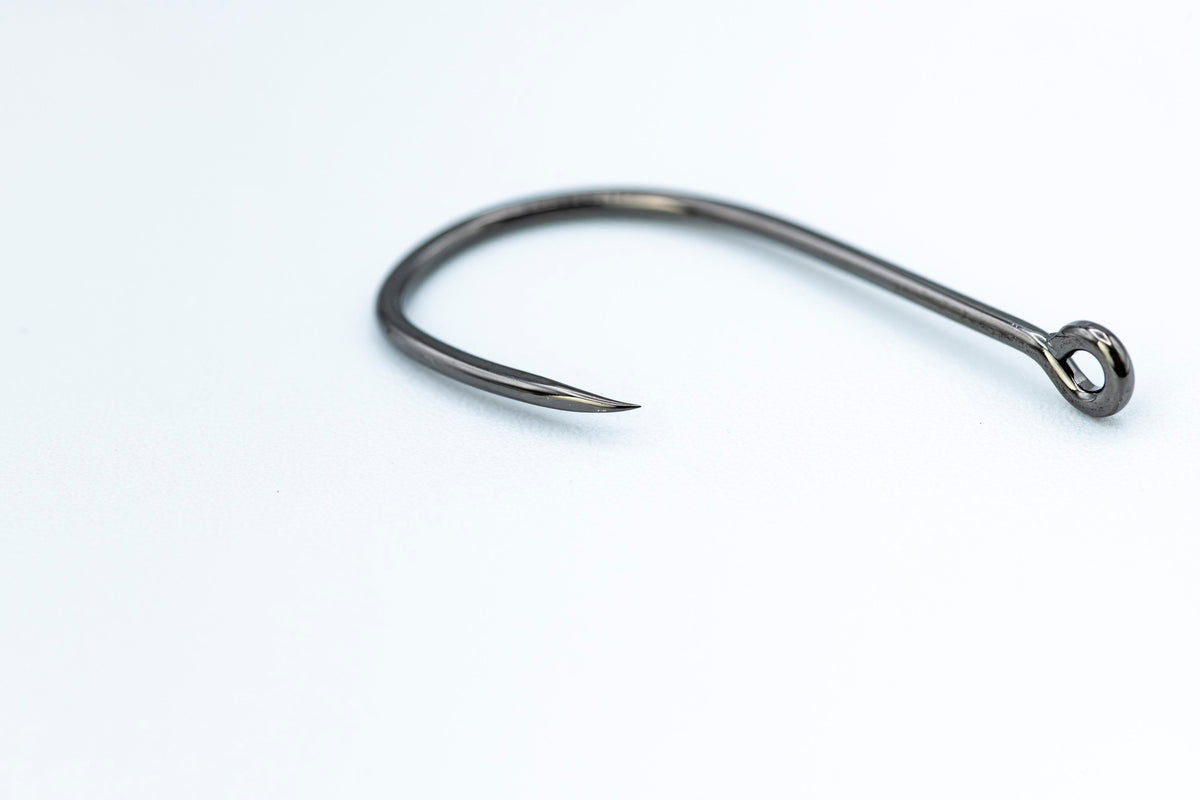
Every hook has a point. Not every point is the same.
Sharpness gets most of the attention, and for good reason. But a hook point is more than simply sharp or dull. Its taper, length, angle, position, and relationship to the rest of the hook all contribute to how easily it penetrates and how the hook performs.
If the point is the first part of the hook a fish encounters, it is worth understanding what makes one good.
What does "sharp" actually mean?
A sharp hook point narrows to an extremely fine tip. The finer and cleaner that tip is, the less force it takes to begin penetrating. Once penetration starts, the rest of the point has to follow.
That distinction matters. A hook can feel sharp at its very tip but transition quickly into a thicker section of steel. Another can maintain a longer, finer taper behind the tip. Both may stick to your thumbnail. They aren't necessarily the same point.
Sharpness begins at the tip, but point geometry continues behind it.
Point taper
Look closely at a hook point and you will see the wire gradually narrow as it approaches the tip. That is the taper.
A longer taper makes the transition from the very fine tip to the full wire diameter more gradual. A shorter taper reaches the full diameter more quickly. Neither tells you everything about whether a hook is good. The point still has to balance penetration with enough material to survive the fishing it was designed for.
A trout dry-fly hook and a heavy streamer hook don't necessarily need identical points. They do both need sharp ones.
Wire diameter and point diameter aren't the same thing
This is an important distinction. A hook made from heavy wire does not have to end in a heavy, blunt point. The wire may be relatively thick through the shank and bend and then taper dramatically toward the tip.
That is why wire weight and point sharpness should be considered separately. Wire tells you about the material used through most of the hook. The point tells you what meets the fish first. A well-designed heavy-wire hook can still finish in a remarkably fine point.
Where the point sits
Point position matters too. Look at a hook from the side and compare the point to the shank. Some points run roughly parallel to the shank. Some angle inward toward it. Others sit farther away.
That position is partly a product of the bend and gape, which is why it doesn't make much sense to evaluate the point completely by itself. The point, gape, and bend form a system. Change one and you change the relationships among the others.
Point styles you'll see
Beyond the basic distinction between a straight point (a fairly direct line from the bend to the tip) and a beaked point (one that curves in toward the shank), you'll run into a handful of named point shapes. The names describe geometry, not quality, but they're worth recognizing:
- Spear point. A flat-ground point roughly in line with the hook. Simple, versatile, and one of the easier points to touch up.
- Needle point. A smooth, round taper to a fine tip. It penetrates easily and does minimal damage, which is part of why it suits catch and release.
- Rolled-in (beaked) point. The tip turns in toward the shank. That angle can improve hookups and helps shelter the point from damage.
- Hollow point. A slight concave curve behind the tip, often favored for soft-mouthed fish.
- Knife-edge point. Sharpened edges on two sides, pointing away from the shank. Used mostly on heavy saltwater hooks for hard-mouthed fish.
All of these have caught fish for generations. As with bend names and X designations, the label tells you the family, not whether the hook is good. Look at the actual point.
What does chemically sharpened mean?
"Chemically sharpened" appears on a lot of hook packaging, but the name can make the process sound more mysterious than it is. The basic idea is controlled removal of steel.
The hook point is first formed mechanically. A chemical or electrochemical finishing process can then remove extremely small amounts of metal from the point, refining its surface and taper and producing a very fine final tip.
Think of it less as creating the point and more as finishing the point at a microscopic scale.
The exact process varies by manufacturer, which is why "chemically sharpened" shouldn't be treated as a guarantee that one hook is sharper than another.
The process matters. The point it produces matters more.
Barbs and penetration
A barb sits behind the point. Once the point begins penetrating, a barbed hook eventually has to move the wider barb through the same opening. A purpose-built barbless hook doesn't have that additional projection.
That is one reason barbless hooks can penetrate efficiently, but the absence of a barb doesn't rescue a poor point. A dull barbless hook is still a dull hook. As we discussed in What Makes a Good Barbless Hook?, removing the barb is only one part of the design. The point still matters. A lot.
How do you know when a hook is sharp?
There are plenty of informal tests. Anglers drag points across thumbnails. They touch them against fingertips. They see whether the hook catches instead of sliding.
Those tests can tell you something, but you don't need to turn hook sharpness into a laboratory experiment at the vise. What you are looking for is a clean, undamaged point that catches with very little pressure rather than skating across a surface.
More importantly, check it again after you fish.
Hooks don't stay sharp forever
A hook can leave the package sharp and become damaged on the first outing. Rocks are especially good at it. So are stream bottoms, logs, boat decks, forceps, and everything else a hook eventually encounters.
The point may roll slightly, flatten at the tip, or develop damage too small to see easily with the naked eye. If a fly suddenly stops sticking the way it did earlier, check the point.
For some hooks, touching up the point may restore it. For very small hooks or badly damaged points, replacing the hook or fly may make more sense. Sharpness isn't something you check once when you open the package. It is something you maintain while you fish.
Sharp isn't the whole hook
We care a lot about sharp hooks. "Stupid Sharp" is printed on our packaging for a reason. But sharpness alone doesn't make a good hook. A great point attached to the wrong wire, gape, bend, or proportions is still the wrong hook for the job.
The point has to penetrate. The gape has to leave enough room to work. The bend has to provide the geometry the design calls for. The wire has to resist the forces the hook is likely to encounter. Everything works together.
How to choose
You don't need a microscope to choose a hook. Start with a point that is genuinely sharp. Then look beyond it.
Consider the point position, gape, bend, and wire. Match the overall hook geometry to the fly you are tying and the fishing you expect to do. And once you're on the water, keep checking the point.
Because no matter how carefully the rest of the hook is designed, everything starts at the tip.
New to the line? Start with choosing a Firehole hook, learn what makes a good barbless hook, or browse the full Firehole Sticks range.

Leave a comment
All comments are moderated before being published.
This site is protected by hCaptcha and the hCaptcha Privacy Policy and Terms of Service apply.