
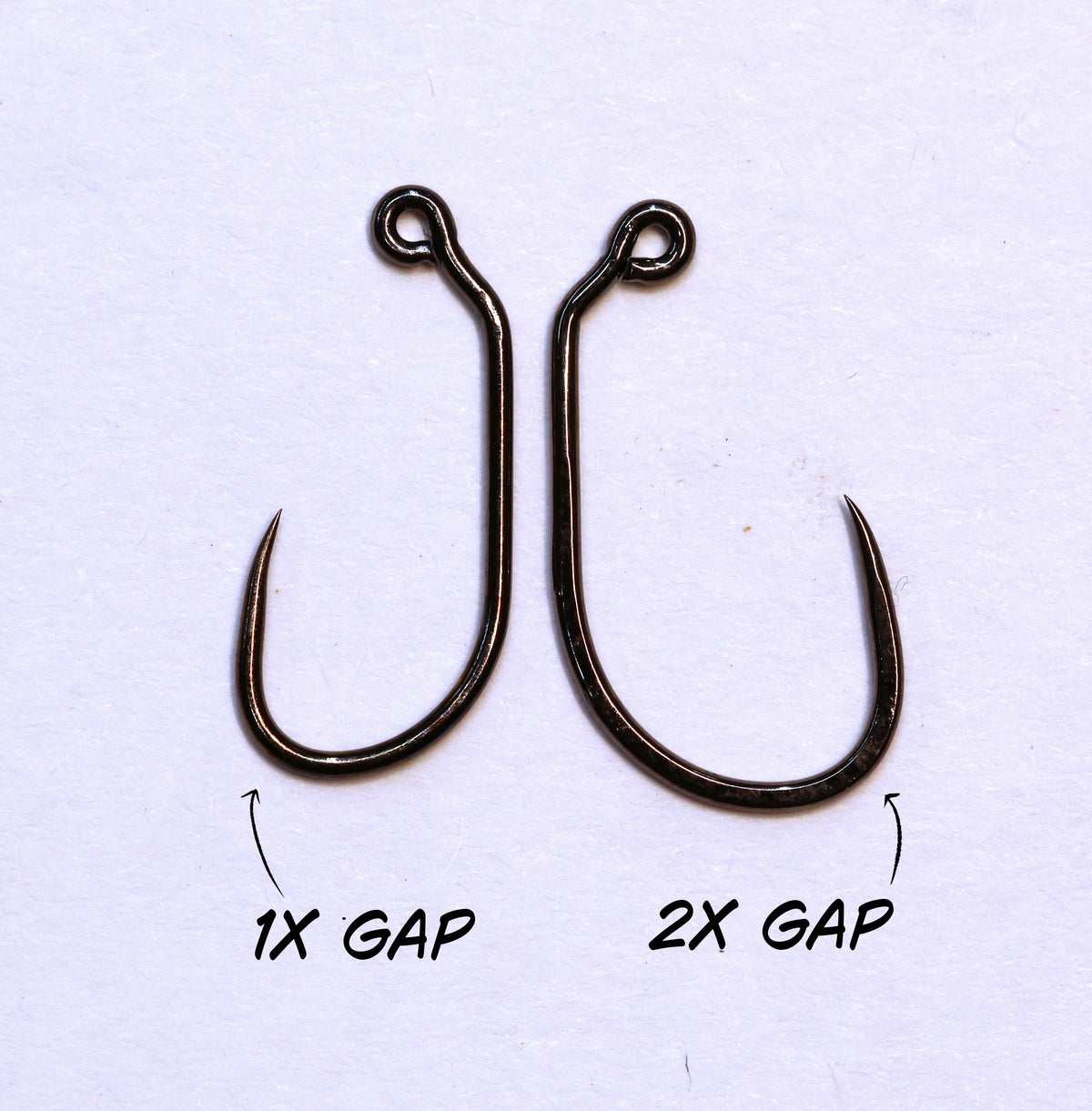
Two hooks can carry the same size number and still give you very different amounts of room between the point and the shank. That space is the gape, and it is one of the most important dimensions on a fly hook.
Gape affects how much room you have to tie the fly, how much of that opening remains once the fly is dressed, and ultimately how much open space remains for the hook point to engage.
What is hook gape?
Hook gape is the distance between the hook point and the shank, measured across the opening of the hook.
It sounds simple, but gape is a big part of what gives a hook its character. A narrow-gape hook can produce a slim, traditional profile. A wide-gape hook opens more space between the point and the shank.
That becomes especially important when you start adding material to the hook.
Measured gape and usable gape
A bare hook has a measured gape. Once the fly is dressed, some of that opening may be occupied by the fly itself.
Wrap a thick body around the shank and some of the open space between the body and the hook point disappears. Add a large bead, bulky dubbing, foam, chenille, or a dense wing and you can crowd it further.
That is why it is useful to think about usable gape: the open space that remains after the fly is tied.
A sparse dry fly may leave almost all of the hook's gape available. A heavily dressed stonefly, hopper, egg, or bead-head nymph can consume much more of it.
The hook didn't change. The amount of open space available to do its job did.
What does wide gape mean?
A wide-gape hook has more distance between the point and shank than the manufacturer's standard geometry for that nominal size.
In the X system, you may see that described as 1X gape, 2X gape, or 2XG. On Firehole hooks, we use XG to identify increased gape.
As with the rest of the X system, don't mistake the designation for an exact measurement. It tells you the direction and relative magnitude of the change. If the actual dimension matters, use the measured dimensions.
Firehole hooks run wide in the gape, and part of the reason is the point. On most of the line, the extra room lets the point turn up toward the eye, closer to the line of pull, without closing off the opening. That helps the point seat on the hookset and stay seated through the fight.
Why would you want more gape?
Usually because something else is taking up space.
A large bead is one example. Moving up a bead size changes the proportions of the fly and may push more material into the hook's working opening, particularly on compact or heavily dressed patterns. A wider gape can help preserve open space below the fly.
The same principle applies to bulky bodies. Foam terrestrials, stoneflies, eggs, heavily dubbed nymphs, and other substantial patterns can occupy enough of the hook that starting with additional gape makes sense.
Wide gape is also useful on short-shank hooks. A hook can have a compact tying platform without necessarily giving up the opening between the point and shank. That combination, short shank and wide gape, lets you tie a relatively small fly while keeping substantial hook opening.
More gape isn't automatically better
If wide gape gives you more room, why not make every hook as wide as possible?
Because hook design is a system.
Change the gape and you change the hook's geometry, including the relationship among the point, bend, shank, and the way the hook carries load. A hook designed for a sparse dry fly doesn't need the same geometry as one designed for a foam terrestrial or a bead-heavy nymph.
The goal isn't maximum gape. It is enough usable gape for the fly you are tying.
Gape and hook size
This is also why the number printed on the package doesn't tell you everything about a hook.
Two size 12 hooks from different models, or different manufacturers, can have different shank lengths, bends, wire diameters, and gapes. Both can legitimately be called a size 12.
The size number gives you a useful starting point. The actual dimensions tell you what the hook really looks like.
This is where hook size, the X system, and wire weight start working together. Size gives you the nominal scale of the hook, traditionally tied most closely to gape. The X designations describe changes in proportion. Wire tells you how much steel is carrying the load. Gape tells you how much room you have to work with.
How to choose
Start with the finished fly, not the number on the package.
If the fly is sparse, you may not need additional gape. If you're tying around a large bead, building a thick body, using foam, or intentionally choosing a short-shank hook, pay closer attention to how much open space remains between the finished fly and the hook point.
Tie the fly, then look at what's left between the body and the point. That is the gape doing the work.
New to the line? Start with choosing a Firehole hook, or browse the full Firehole Sticks range.

Leave a comment
All comments are moderated before being published.
This site is protected by hCaptcha and the hCaptcha Privacy Policy and Terms of Service apply.