
Look at enough fly hooks and you start to notice that the bend isn't always the same.
Some make a nearly perfect round turn. Others sweep gradually from the shank into the point. Some are deep and open, others compact and tight. And then there are names, round bend, sproat, limerick, scud, stinger, that don't always mean exactly the same thing from one manufacturer to another.
The bend is more than the curved part at the bottom of a hook. It helps determine the hook's gape, depth, point position, and overall proportions. Understanding it makes comparing hooks a lot easier.
What is the hook bend?
The bend is the curved section connecting the shank to the point. Simple enough. But change the shape of that curve and several other parts of the hook change with it.
A deeper bend can put the bottom of the hook farther below the shank. A more open bend can change the relationship between the point and shank. A continuous curve can eliminate much of the distinction between where the shank ends and the bend begins.
That is why two hooks with similar shank lengths and gapes can still look very different. The bend connects the geometry.
Gape and bend are not the same thing
This distinction matters.
Gape is the opening between the point and the shank. Bend depth describes how far the hook extends below the shank. They are related, but they aren't interchangeable.
Two hooks can have similar gapes while one has a much deeper bend. They can also have similar overall depth while positioning the point differently relative to the shank.
If you only look at hook size, or even gape, you are still missing part of the picture.
Round bends
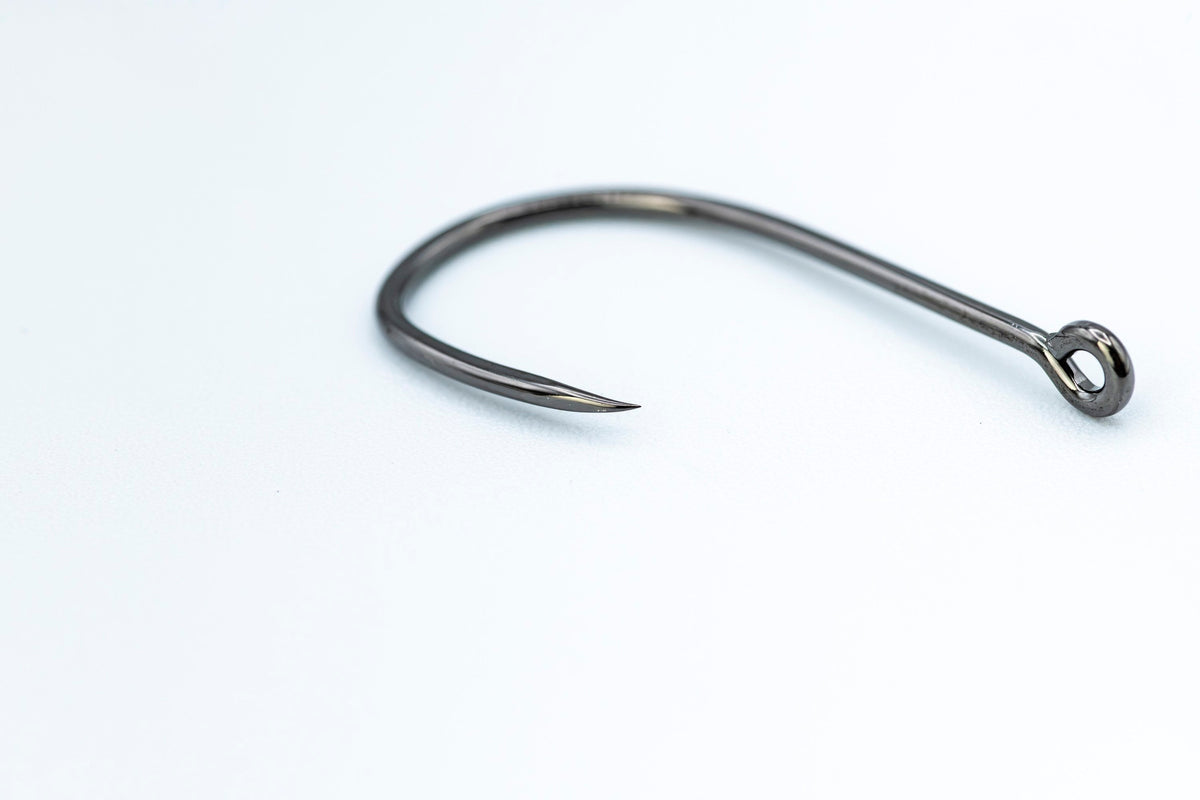
A round bend makes a relatively even curve through the bottom of the hook. The classic Model Perfect is one particularly symmetrical form of round bend, with an even half-circle from shank to point.
It is one of the most familiar hook shapes and appears across dry flies, nymphs, wets, streamers, and many other styles. There is a reason it is so common: it produces simple, versatile geometry. Many Firehole hooks are round bends, including the 419 dry, the 609 nymph, and the 633 nymph.
But "round bend" doesn't tell you everything. The same basic bend can be paired with different shank lengths, wire weights, gapes, eyes, and point positions to produce very different hooks. Think of round bend as a description of the curve, not a prescription for what fly belongs on it.
Sproat and limerick bends
A sproat bend is typically gentler on the shank side and tighter as it turns up toward a relatively straight point. Historically, sproat-style bends have appeared on a wide range of wet-fly, nymph, and general-purpose hooks.
A limerick bend typically has a flatter bottom and turns sharply up toward the point, putting more of the curve on the point side of the hook. Limerick bends have appeared on salmon, wet-fly, dry-fly, and other specialty patterns.
Anglers and hook makers have long associated both with particular penetration and holding characteristics. Those outcomes depend on the whole hook, not the bend name alone.
And this is where hook terminology starts getting messy. "Sproat" can describe somewhat different geometry depending on the manufacturer and era. The name is useful for recognizing a family of shapes, but it isn't a dimensional standard. If two hooks are both called sproat bends, don't assume they are identical. Look at the hooks.
Bend shape and strength
Bend shape changes how load moves through the hook. Even with the same wire, a different curve spreads or concentrates stress in different places. Two hooks made from the same wire can resist opening differently because their geometry is different.
But there is no simple rule that one named bend is always stronger than another. Steel, heat treatment, wire diameter, forging, gape, and overall geometry all matter. We cover that in more depth in How Strong Is a Fly Hook?
Continuous and curved bends
On some hooks, deciding where the shank stops and the bend starts isn't easy. The entire hook sweeps through a continuous curve.
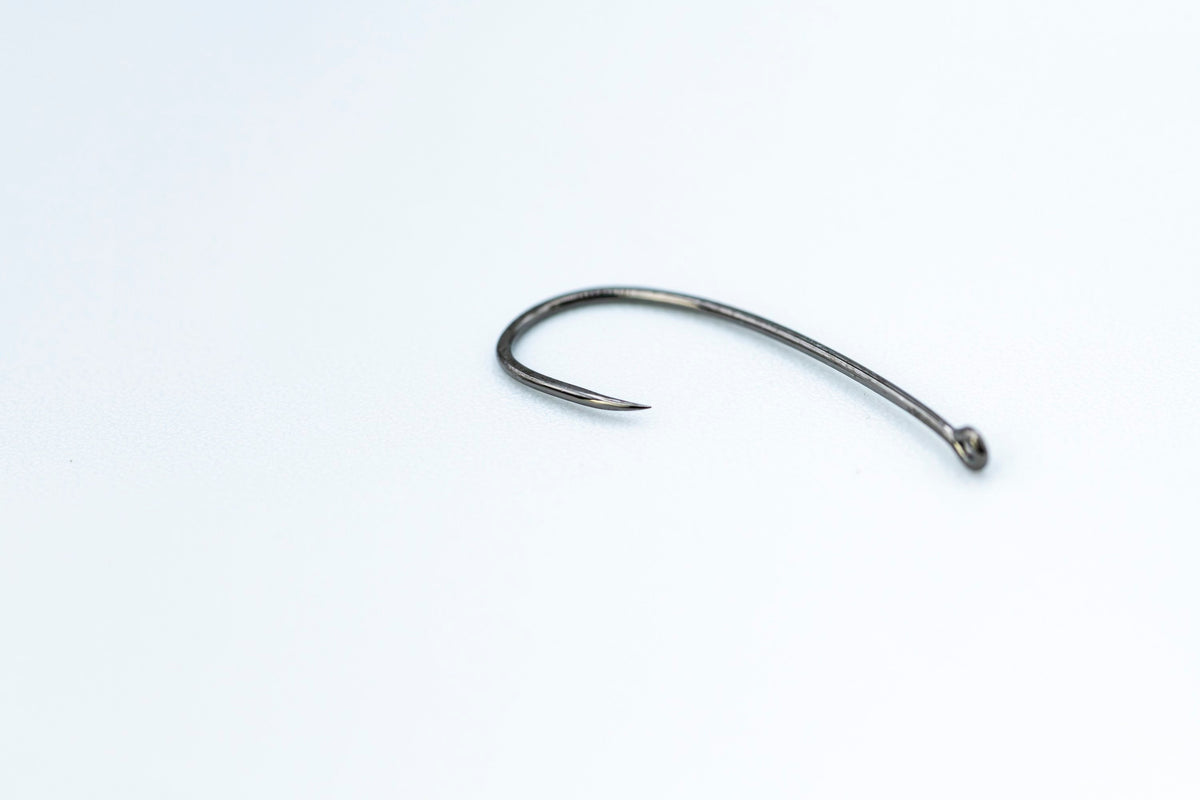
These shapes are common on hooks used for scuds, caddis larvae, emergers, pupae, and other patterns where a curved body profile is useful. Firehole's 300-series hooks are continuous-curve designs, including the 315, 317, and 320, used for scuds, pupae, emergers, and klinkhammer-style flies.
Here the bend is doing double duty. It isn't only forming the bottom of the hook, it is also creating the tying platform. That makes the shape of the hook part of the shape of the finished fly.
A curved hook can help suggest the natural posture of a larva or pupa without requiring the tyer to create all of that shape with materials.
The curve changes the point, too. Because the hook already sweeps the point around, the point on our 300 series needs less upturn toward the eye than it does on the rest of the line.
Specialty bends
Then there are hooks whose bends are designed around a particular style of fly or a particular set of proportions. You will see terms such as stinger, egg, grub, terrestrial, and wide-gap used to describe some of these hooks.
Those names can be helpful, but they can also cause confusion because they mix geometry with intended use. A "scud hook," for example, tells you something about what people commonly tie on it, but another tyer might look at exactly the same geometry and see an emerger hook.
The fly doesn't know what the package called the bend. That is why it is more useful to learn to see the geometry itself.
Look at where the point ends up
One of the most useful ways to compare bends is to look at the point. Where does it sit relative to the shank? How much open space is there between the point and the finished fly? How deep is the bend below it? Does the point aim toward the shank, run roughly parallel to it, or follow some other angle? Then look down the shank from above: does the point sit in the same plane, or is it offset to one side?
Those relationships tell you more about the hook than the bend name alone. They also connect bend shape directly to hook gape. A hook may be described as wide gape, but the bend and point position determine what that opening actually looks like.
Bend shape and the fly you are tying
At the vise, bend shape becomes another tool for controlling proportions.
For a conventional dry fly or nymph, you may want a relatively straight shank followed by a familiar round or sproat-style bend. For a scud or caddis pupa, a continuous curve can become part of the body profile. For a bulky terrestrial, egg, or other heavily dressed fly, you may care more about preserving usable gape and choosing a bend that leaves enough open space after the materials are added.
The important thing is not matching a pattern name to a bend name. It is matching the hook geometry to the fly you want to build.
Don't get hung up on the names
This is the same lesson that comes up repeatedly with fly hooks. The terminology is useful. The measurements and geometry are better.
There is no universal standard requiring every manufacturer to make a "round bend," "sproat," "scud," or "stinger" hook to exactly the same shape. Use the name to understand what kind of hook you are looking at. Then look at the actual hook.
Consider the shank. Look at the gape. Look at the depth of the bend and where the point sits. Consider the wire weight and eye style. Together, those things tell you what the hook actually is.
How to choose
Start with the fly. Ask what body shape you need, how much tying platform you want, and how much open gape should remain once the fly is finished. Then choose the bend that helps create those proportions.
Don't choose a hook simply because the package says "nymph," "scud," or "terrestrial." Learn to see the shape instead of the name. Once you do, a wall full of different hooks starts making a lot more sense.
New to the line? Start with choosing a Firehole hook, or browse the full Firehole Sticks range.

Leave a comment
All comments are moderated before being published.
This site is protected by hCaptcha and the hCaptcha Privacy Policy and Terms of Service apply.